
Which radio to choose for a hunt in Belgium?
For a hunt in Belgium, you have two options to communicate by radio :
→ PMR-446 : up to 0.5 W, no license if the radio complies with the specified conditions.
→ Hunting radio : up to 5 W on the 8 frequencies allocated for hunting, with an IBPT license required.
These are two different systems. A 5 W VHF hunting radio is not simply a more powerful PMR-446.
Once this point is settled, the real choice is made in the field : range, autonomy, robustness, ergonomics and communication quality. Because between two stations separated by a few hundred meters, a ridge or a dense forest can completely change the game.
Here are the 7 criteria to consider before choosing your hunting radio in Belgium.
1. La légalité : commence par choisir le bon système
⚠️ Not all radios you find on the internet can be used freely in Belgium.
The PMR-446: simple and license-free
The radios PMR-446 are a free-to-use solution when they comply with the conditions set by the IBPT.
These radios use the band 446.0 to 446.2 MHz and are limited to 0.5 W. The antenna must be integrated into the device and the equipment must meet applicable requirements, including CE marking.
⚠️ A PMR-446 of more than 0.5 W is not allowed.
VHF hunting radio: up to 5 W with authorization
For hunting, the IBPT also provides 8 specific frequencies, with a maximum power of 5 W, usable throughout Belgium with the corresponding authorization.
These VHF frequencies specific to hunting are not PMR-446 frequencies. Their use requires the corresponding authorization in Belgium.
L’autorisation peut notamment être obtenue via le Royal Saint-Hubert Club ou directement auprès de l’IBPT.
Visit the Royal Saint-Hubert Club website See the IBPT website
First reflex: check the radio system, the frequencies, and the necessary authorization before only looking at the power.
- 0.5 W in PMR-446: free use if the equipment is compliant.
- Up to 5 W on hunting frequencies: authorization required.
| Channel | Frequency |
|---|---|
| 1 | 154.49375 MHz |
| 2 | 154.50625 MHz |
| 3 | 154.51875 MHz |
| 4 | 154.55625 MHz |
| 5 | 154.56875 MHz |
| 6 | 154.58125 MHz |
| 7 | 154.59375 MHz |
| 8 | 154.60625 MHz |
2. The range: forget the kilometers advertised on the box
It’s probably the question number 1 for hunters looking for a good hunting radio: “What is its range?”
“Up to 10 km range.” You’ve seen that before.
On perfectly clear ground, why not. In a hilly Belgian forest, it’s another story.
5 W ≠ 10 km guaranteed
A station on a ridge and another at the bottom of a valley can have difficult communications even though they are only separated by a few hundred meters.
The right reflex
Don’t just look for the maximum range. Look for a radio whose communication is suitable for your area.
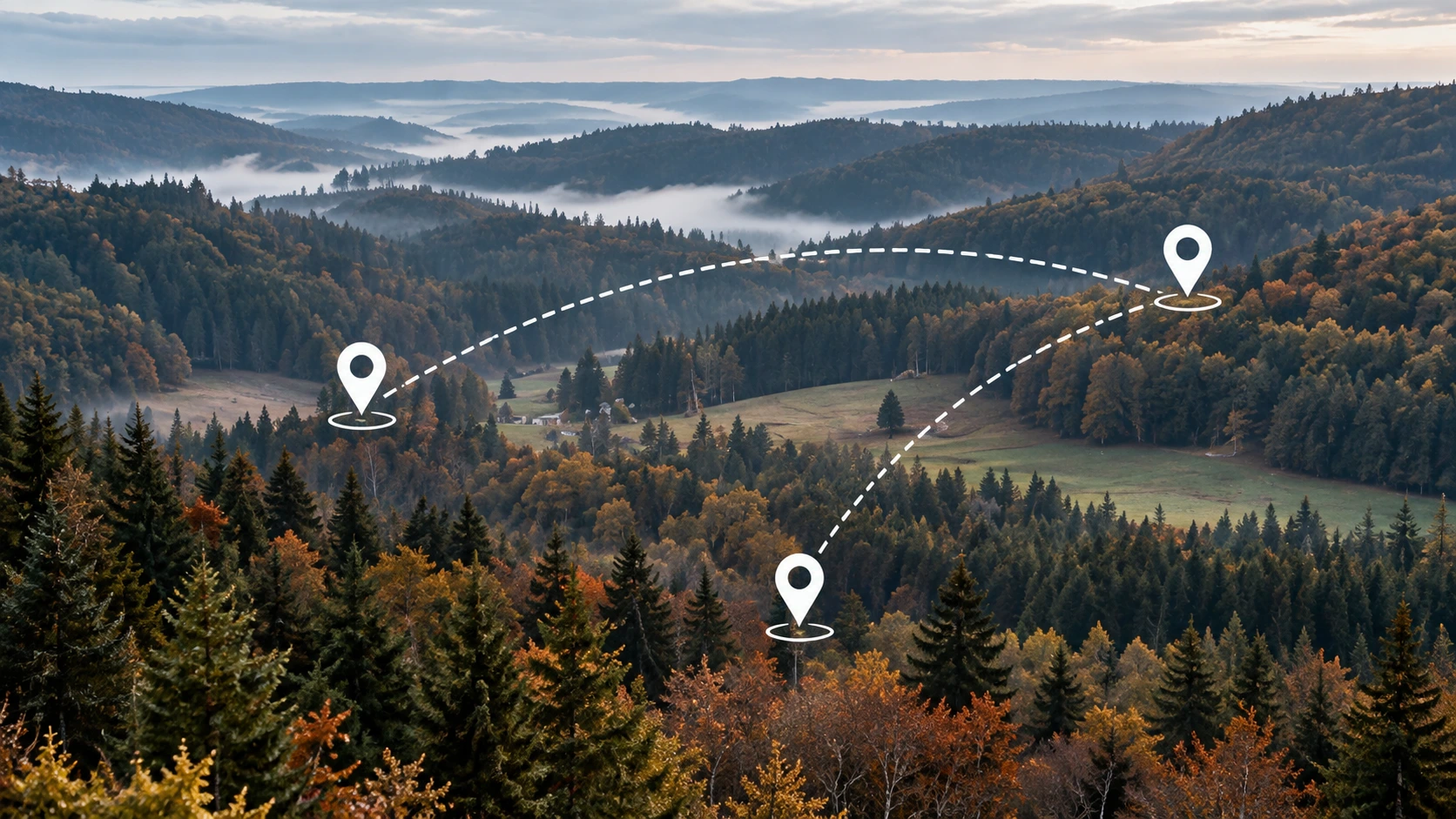
Even better: test it. Before the season, place two radios at representative positions of your hunt. Try from a ridge, a valley, and a wooded area. The field is the best testing ground.
The antenna : a real plus for range
The radio does not do it all : the antenna also affects the quality of transmission and reception. Depending on your terrain and needs, a flexible antenna can help optimize your equipment.
⚠️ A longer antenna does not automatically mean twice the range. Performance also depends on the frequency used, the antenna's alignment, the radio, the terrain, and any obstacles present in the area.
Their flexible design allows for good maneuverability in the field, while providing an alternative to the original antenna.
See our products : Flexible antenna 39 cm · Flexible antenna 48 cm
3. Battery life: because at 0%, even the best radio is not very useful
A hunt can last several hours. Your radio must keep up and last all day.
Good battery life is therefore an obvious criterion, but often underestimated at the time of purchase.
Remember to check:
- the advertised battery life;
- the type of battery;
- the charging time;
- the possibility of having an extra battery;
- the battery's performance in cold weather.
And above all, adopt a simple habit: radio charged before leaving.
It's not very sophisticated. It's just reliable.
Two batteries, it’s real security
The point is simple: you can keep one charged battery in your bag and replace it immediately if necessary.
No need to look for a socket in the middle of the woods.
A backup battery takes up little space. A flat radio can make you lose contact with your team.
4. Ergonomics: test it with your gloves
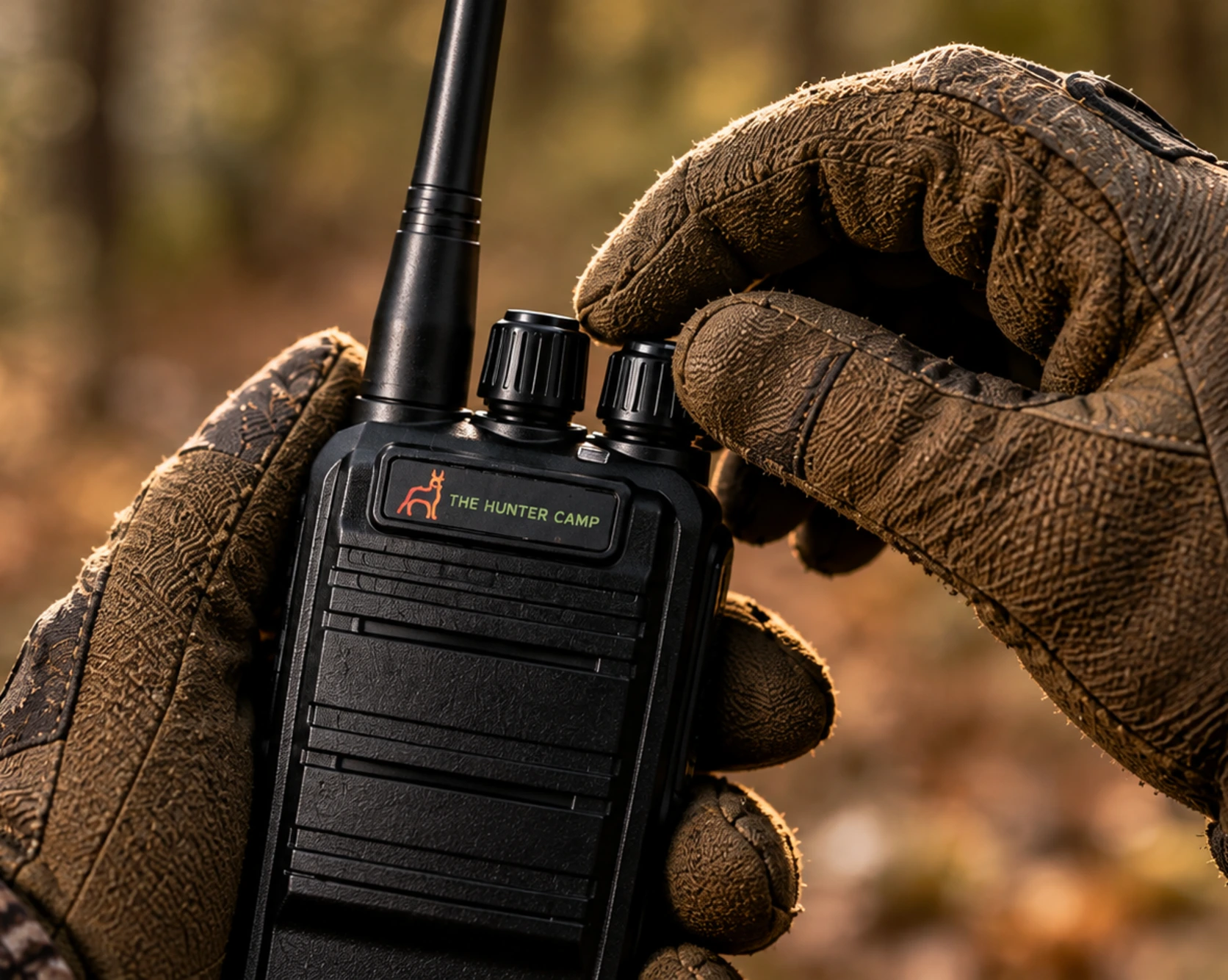
A radio can be excellent on paper and painful to use in the woods.
You must be able to operate your radio without taking your eyes off your surroundings.
For a hunt, you must be able to:
- quickly find the PTT button;
- adjust the volume without difficulty;
- simply change the channel ;
- immediately understand the state of the radio ;
- manipulate the device without needing to look at every button.
- avoid accidental operations in a pocket.
Fewer buttons, fewer menus, and fewer unnecessary operations: it’s often more effective in the field.
A simple function that matters: voice announcement
On the The Hunter Camp radio, when you change channels, the radio vocally announces the selected channel: “Channel 1,” “Channel 2,” etc. It may seem secondary.
With gloves, in dim light, or when markings become less readable, not having to look at the screen to know which channel you are on is quite handy.
5. Robustness: the forest is not a showroom
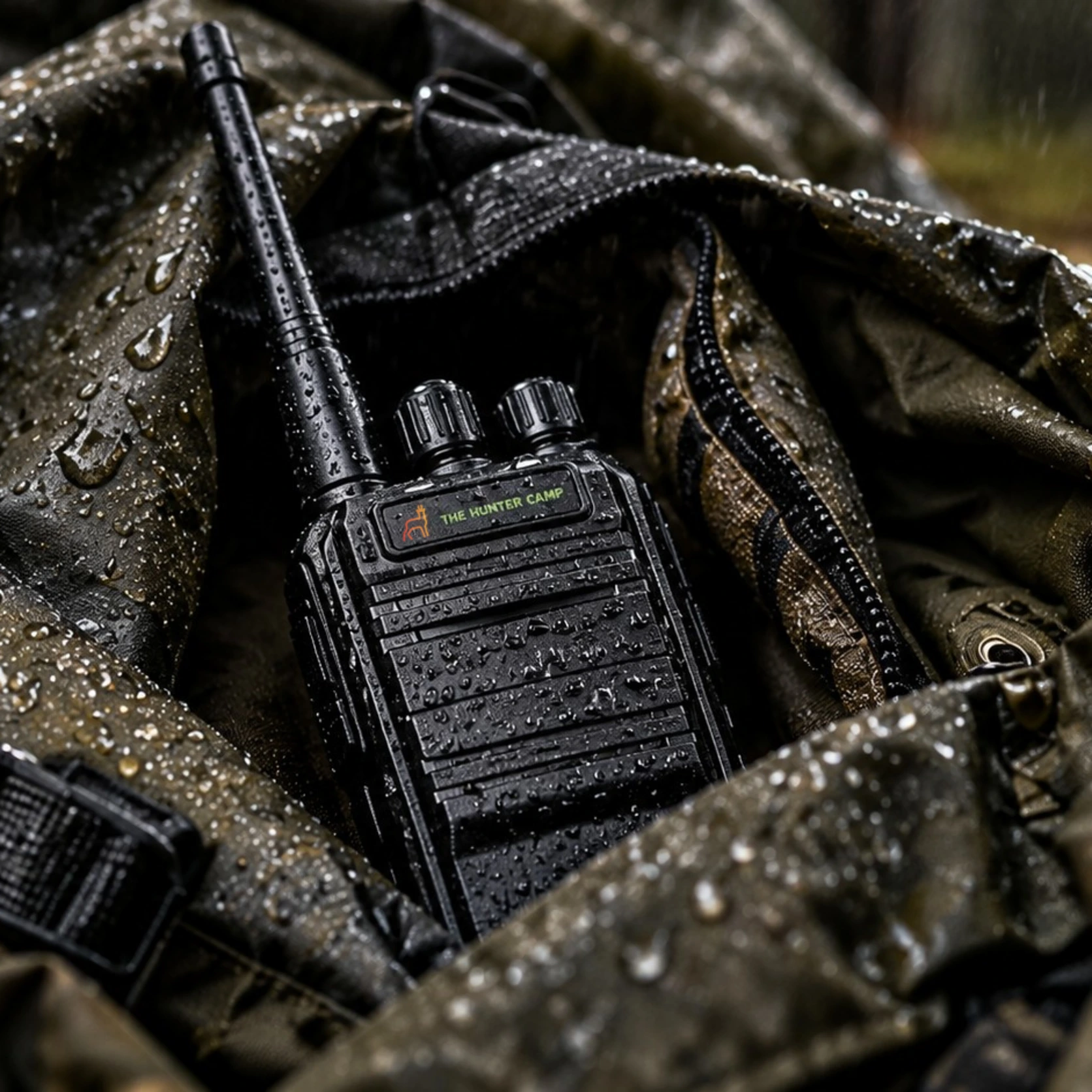
A hunting radio is not meant to stay on a desk. It will live outside
It can get wet, fall into leaves, be attached to a jacket, or end up in a pocket with the rest of the gear.
So prioritize a construction robust and suitable for regular outdoor use. Look in particular at :
- water and dust resistance ;
- the quality of the casing ;
- the protection of the controls ;
- the grip.
No need for a complicated device. It just needs to withstand the conditions in which you actually hunt.
6. Audio quality: "can you hear me?" is not a communication strategy
On a hunting radio, sound matters a lot. You don't need studio audio quality. You need to quickly understand information.
A good radio must remain clear enough when:
- you are outside ;
- there is wind ;
- you are wearing thick clothing ;
- multiple people are communicating ;
- the volume must be loud enough.
It's a detail until the moment someone transmits important information and you have to ask them to repeat it three times.
Clear sound is comfort. And sometimes, it's mainly less confusion.
7. Simplicity: fewer functions, more field
Bluetooth, GPS, dozens of menus, settings everywhere…
But ask yourself if you really need it.
For a drive, the essential functions often remain very simple: listen → press → talk → release.
A reliable radio is a radio that the whole team knows how to use.
On the day of the drive, it's not the time to discover how to change channels.
Why Valentin created his own hunting radio
A radio developed by a hunter, for the field
The Hunter Camp radio was not born from a simple commercial specification.
It was developed by Valentin, founder of The Hunter Camp and regular user of radios in the field.
"I used radios. I identified what annoyed me. I wanted something simpler. So I had it made.".
The goal was clear : a powerful, robust, easy-to-use radio, with good battery life and without multiplying unnecessary functions.
There was also another constraint : the price. Why pay a significant premium just for the name on the radio if the truly useful features can be gathered in a more accessible device?
The Hunter Camp therefore works directly with the factory to limit intermediaries and focus the cost on what really matters to the hunter.
The Hunter Camp radio in a few numbers
- 5 W transmission power,
- 8 VHF channels dedicated to hunting in Belgium,
- 2 lithium-ion batteries of 3,800 mAh,
- Voice announcement of the channel
- Robust design
100% compliant with Belgian legislation
The goal was not to make a radio with as many features as possible. The goal was to make a radio that Valentin would actually want to have in his pocket during a hunt.
PMR-446 or licensed hunting radio?
This is the real choice for many Belgian hunters.
| Criterion | PMR-446 | Hunting frequency radio |
|---|---|---|
| Authorization | No, if equipment is compliant | Yes |
| Max power. | 0.5 W | 5 W |
Band | UHF | VHF |
| Hunting use | Yes | Yes |
Antenna | Integrated | Depending on the equipment and authorization |
| Simplicity | Very high | High |
| Long distances / terrain | Depends heavily on the terrain | May be more suitable |
| License | No | Yes |
| Usage | PMR-446 frequencies | Assigned hunting frequencies |
The 5 W obviously do not guarantee a given range. They represent a technical characteristic within a regulated framework. The terrain remains decisive in the field. There is therefore no "better" radio in absolute terms. There is a radio more suited to your use.
Price matters too
A 5 W VHF radio from a major brand can quickly reach several hundred euros once you add the battery and the charger.
The goal of The Hunter Camp is different: to offer the features that are truly useful in a hunt, with two 3,800 mAh batteries included, while keeping the price accessible.
The choice is therefore not just about comparing two prices displayed on a product sheet.
Compare what is actually delivered in the box.
And above all, compare what is actually useful in the field.
So, which radio for your next hunt in Belgium?
If you are hunting in a relatively compact area and want a simple solution, a compliant PMR-446 may be sufficient.
If your area is vast, rugged, and the distances between posts are significant, a radio using specific hunting frequencies with the appropriate authorization may be more relevant.
In this case, look primarily at: the actual range → the antenna → the battery life → the ergonomics → the durability → the audio → the simplicity.
Because a hunting radio is not the one that displays the biggest number on its box.
It is the one that works when you are deep in the woods, in the rain, with your gloves on and several hundred meters of forest between you and your neighbor.
And that, only real field use can verify.
To remember: in Belgium, always check that your equipment and its mode of use comply with the conditions set by the IBPT. The rules may evolve: check the current regulations before your hunting season.
The configuration we recommend for a hunt
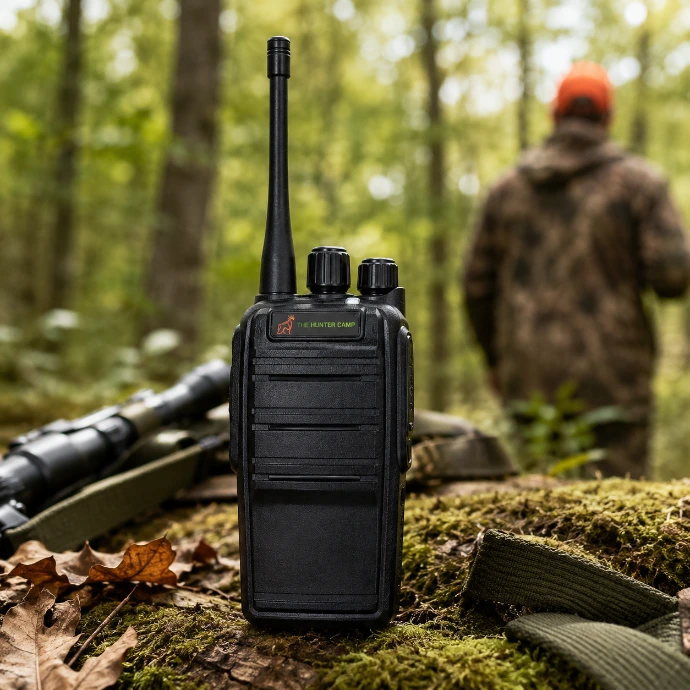
A main radio, a spare battery, and a suitable antenna: the essentials to stay reachable without weighing down your gear.

Valentin's opinion
Before looking at the kilometers stated on the box, test your radio in your area. One station in the valley, another behind the line of woods: that's where you'll see if the communication really holds.
The field remains the best testing ground.
FAQ - Frequently Asked Questions
You mainly have the choice between a PMR-446 up to 0.5 W without a license, if it is compliant, and a VHF radio using frequencies specific to hunting up to 5 W, with authorization. The choice then depends on the terrain, the distances between the stations, and your need for autonomy and robustness.
It depends on the system used. A compliant PMR-446 can be used without authorization. The specific frequencies assigned to hunting require authorization.
A license can be obtained through the Royal Saint-Hubert Club, which has licenses with the IBPT, or directly from the IBPT.
The conditions, validity periods, and fees depend on the type of license. Always check the official information before your hunting season.
A PMR-446 is limited to 0.5 W. The specific frequencies assigned to hunting allow up to 5 W with the corresponding authorization.
No.
The fact that a radio can transmit at 5 W does not mean you can use it freely.
For the relevant hunting frequencies, a permit is required. Therefore, you need to check both the equipment, the frequencies used, and the conditions of use.
Not automatically.
Power is an important factor, but the terrain and obstacles play a major role.
In the forest, a ridge, a valley, or a high density of vegetation can significantly alter communications.
More power does not turn a radio into a satellite phone.
A suitable antenna can improve transmission and reception conditions, but longer does not automatically mean more range. Frequency, antenna adjustment, the radio, and the terrain also play a role.
Things to remember before buying your hunting radio
You don't need to spend an hour comparing 25 features.
Look at these 7 points :
- Legality — what frequencies and what authorization?
- Actual range — how does it perform in your area?
- Battery life — will it last all day?
- Ergonomics — can you use it with your gloves?
- Durability — will it really withstand the terrain?
- Audio — can you clearly understand communications?
- Simplicity — does the whole team know how to use it?
The right hunting radio is not the one that shows the biggest number on the box.
It's the one you can easily handle, that remains reliable in your environment, and that allows you to stay in touch with your team when the hunt really begins.