
You have certainly experienced this situation before: you observe an animal from a distance with your binoculars. You can make out its silhouette, but when you try to examine a detail, the image shakes. You adjust your position, hold your breath, try to stabilize your arms… without always achieving the desired result.
This phenomenon is particularly noticeable with high magnification binoculars. The closer you bring the image, the more the small movements of your hands become perceptible.
It is precisely to address this difficulty that the stabilized binoculars have been developed.
But what is this technology really for? Is it useful for hunting? Does it replace traditional binoculars? And do you necessarily have to invest in a stabilized model to effectively observe game?
Here’s what you need to know before making your choice.
Stabilized Binoculars: The Essentials
Stabilized binoculars incorporate a system that compensates for some of the natural movements of the hands to make the image more stable.
Their main advantage is to facilitate the use of high magnification handheld, without having to set up a tripod every time.
They are particularly interesting for:
observing animals at long distances;
examining details with high magnification;
monitoring large areas;
improve comfort during prolonged observations.
On the other hand, they are not necessarily the best choice for all hunting practices. Weight, autonomy, brightness, and budget remain important criteria.
How do stabilized binoculars work?
With classic binoculars, the image naturally follows the movements of your hands. Even with a good position, small oscillations are inevitable. At low magnification, they are generally not very bothersome. But when moving to 12×, 15×, or 16×, they become much more noticeable.
Stabilized binoculars use a compensation device to limit these movements.
Depending on the technologies, the principle may vary. Some systems detect movements using electronic sensors, then command the movement of an optical element, such as a lens or a prism. Others rely on optomechanical mechanisms.
The goal remains the same: to compensate for some of the movements of the binoculars to maintain a more stable image.
One thing to remember: stabilization acts on the shakes caused by your movements. It does not alter the fundamental optical capabilities of the binoculars.
It does not make an image brighter, does not correct haze, and does not eliminate atmospheric turbulence.
What is the benefit of stabilized binoculars for hunting?
For a hunter, binoculars are an essential observation tool. They allow you to cover a territory, monitor an edge, examine a slope, or observe wildlife behavior.
Stabilization becomes particularly important when distance and magnification make observation more demanding.
1. Observe game at long distance
When you observe a distant animal, significant magnification can help you distinguish more details.
But the higher the magnification, the more the shakes become bothersome. Stabilization allows for better use of this closeness and limits unwanted movements of the image.
This is particularly interesting in open spaces, in the mountains, or in large plains.
2. Examine a border or an extensive area
Observation does not always consist of looking at an already spotted animal. Sometimes you need to methodically scan an area to identify movement or presence.
A more stable image makes it easier to read the landscape and allows you to sweep an area with more comfort.
3. Observe from a fixed position
From a lookout, a blind, or an observation point, you may need to examine a distant area for a long time.
Stabilized binoculars allow you to enjoy high magnification without having to systematically set up a support.
4. Follow a scene without losing visual comfort
An animal that is moving, a group of deer crossing an open space, or a rapidly evolving observation scene: the stability of the image can facilitate visual tracking.
It obviously does not replace good binocular handling technique, but it reduces a well-known difficulty for users of high magnifications.
Stabilized binoculars or classic binoculars: what are the differences?
This is probably the most important question before a purchase.
Stabilized binoculars are not necessarily better than classic binoculars. They simply meet a different need.
| Criterion | Classic binoculars | Stabilized binoculars |
|---|---|---|
| Handheld stability | Depends on the position and magnification | Shakes reduced by the stabilization system |
| High magnification | More demanding to use | More comfortable to operate |
| Power supply | Not necessary | Necessary depending on the technology |
| Weight | Very variable depending on the model | Very variable depending on the model |
| Usage | Very versatile depending on the features | Particularly interesting at high magnification |
| Maintenance | Generally simple | May require additional attention to the electronic system |
When to choose classic binoculars?
They are often perfectly suited if you are looking for:
Versatile equipment for various hunting scenarios;
A simple design that requires no power source;
Good light transmission for observation in challenging conditions;
Lightweight gear, ideal for long outings;
Moderate magnification, such as 8× or 10×.
When to choose stabilized binoculars?
They become particularly interesting if:
You frequently observe at long distances;
You want to use high magnification while holding the binoculars by hand;
Hand tremors interfere with your ability to observe;
You spend time scanning distant areas;
You prefer not to carry a tripod with you at all times.
Ultimately, the right choice depends less on the technology itself and more on your personal observation habits.
What magnification to choose for stabilized binoculars?
Magnification determines how many times the observed image is enlarged.
A pair of 8× binoculars brings the image eight times closer. With a 10× model, it is brought ten times closer. A 16× model allows you to observe a distant subject with a significantly greater magnification.
But be careful: a high magnification does not automatically mean better observation.
The higher the magnification increases:
the more hand movements are visible;
the narrower the field of view generally is;
the more focusing and tracking a subject may require precision;
the more perceived brightness depends on the optical characteristics of the model.
Stabilization helps to control the first point, but does not eliminate the other constraints.
8×, 10× or 16×: what are the differences?
| Magnification | Preferred use |
|---|---|
| 8× | Versatile observation, generally comfortable field of view |
| 10× | Good compromise for observing at a distance while maintaining versatile use |
| 12× and above | Observation of distant subjects, with increased stability requirements |
| 16× | Strong magnification for examining distant areas and subjects |
For versatile use in hunting, the 8×42 and 10×42 models remain interesting references.
If you are primarily looking for high magnification for long-distance observation, a stabilized 16× model may be much more suited to your needs.
Are stabilized binoculars effective in low light?
This is an essential point, especially for hunters who observe early in the morning or at the end of the day.
Stabilization improves image stability, but it does not increase the amount of light captured by the lenses.
To evaluate the performance of a pair of binoculars in low light, you should particularly look at:
the diameter of the objectives;
the magnification;
the quality of the glass and optical coatings;
the exit pupil.
The exit pupil is calculated by dividing the diameter of the objectives by the magnification.
For example:
8×42 binoculars offer an exit pupil of 5.25 mm;
10×42 binoculars offer an exit pupil of 4.2 mm;
16×42 binoculars offer an exit pupil of 2.625 mm.
The larger this value, the wider the beam of light that exits the binoculars. This can be an advantage when ambient light decreases, even if optical quality and observation conditions remain decisive.
To remember: if you primarily observe at dusk, choose binoculars that offer good brightness. If your main need is for long-distance magnification, high magnification combined with stabilization may be more interesting.
What are the disadvantages of stabilized binoculars?
The technology has real advantages, but it also involves some constraints.
An electrical power supply
Electronic stabilization systems operate with batteries or a battery. Therefore, it is necessary to monitor the autonomy and provide a backup power supply for extended outings.
A sometimes heavier weight
The presence of a stabilization system can increase the weight and bulk of binoculars. This is a criterion not to be overlooked when you are covering long distances.
A generally higher budget
The embedded technology and its design can represent an additional cost compared to traditional binoculars.
A technology that does not correct everything
Stabilization does not compensate for the effects of haze, air turbulence, or the resolution limits of optics. It also does not turn low-light binoculars into binoculars suitable for twilight.
Therefore, stabilization should be considered as an additional tool, not as a universal solution.
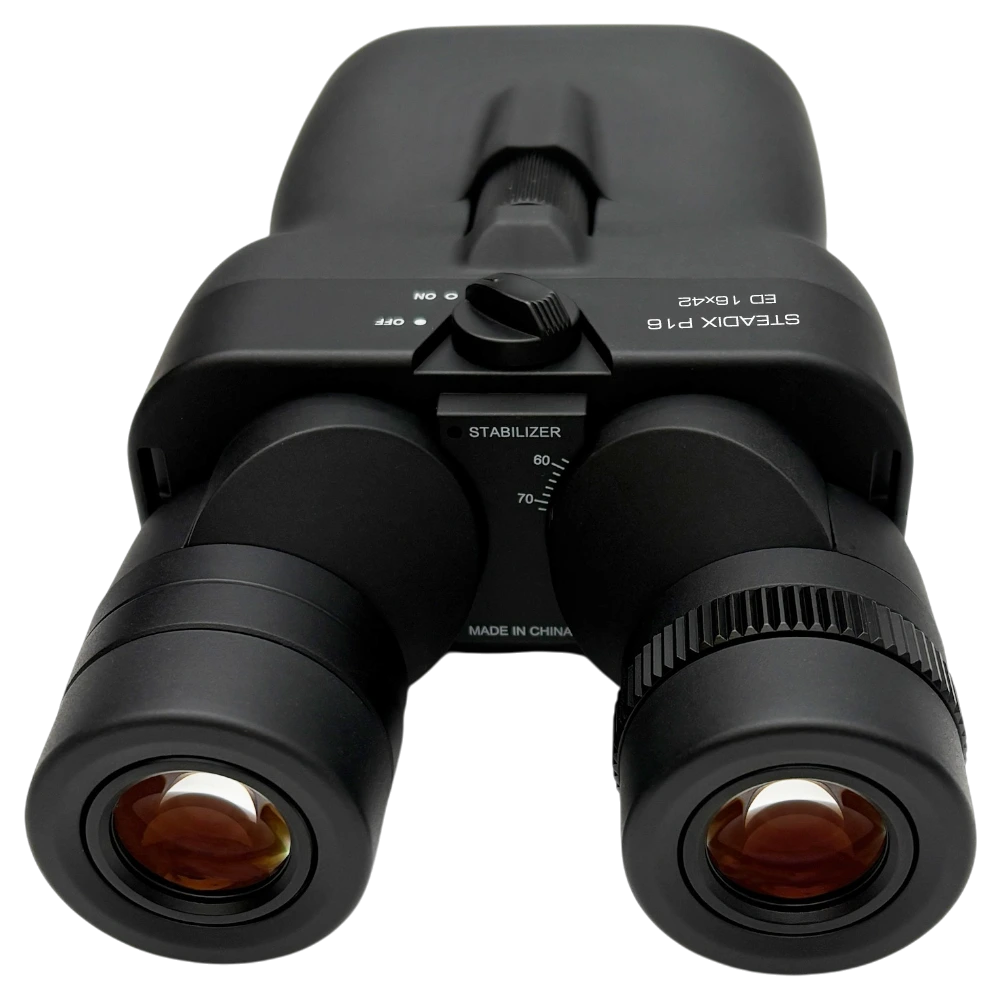
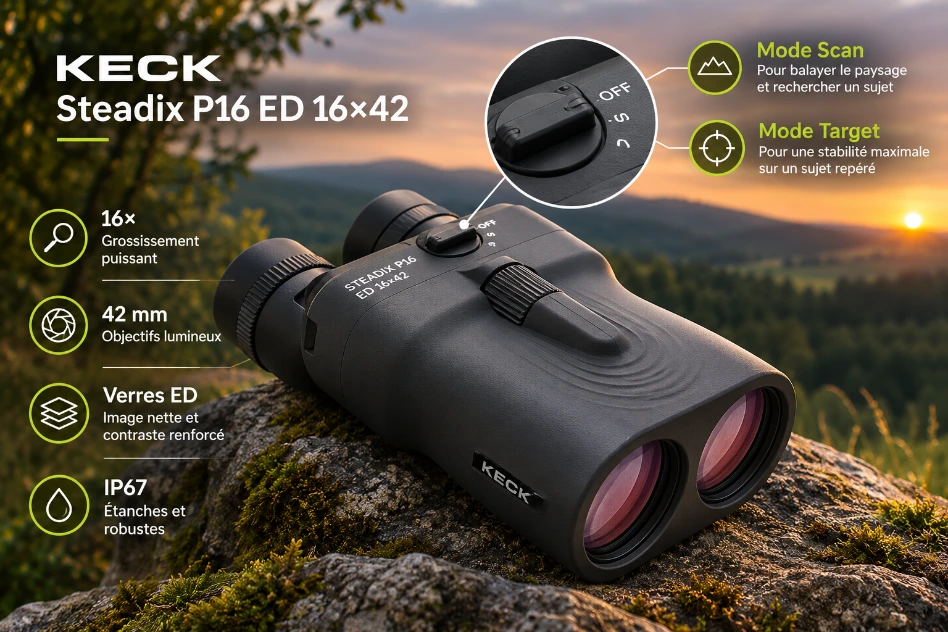
An example of stabilized binoculars for hunting: the Keck Steadix P16 ED 16×42
If you are looking for high magnification combined with electronic stabilization, the Keck Steadix P16 ED 16×42 are an option to consider. They combine 16× magnification with 42 mm objectives and integrate two stabilization modes:
Scan, designed to scan the landscape and search for a subject.
Target, intended to enhance stability when you want to observe a spotted subject.
They also feature ED glass, designed to limit chromatic aberrations, as well as IP67 protection and nitrogen filling.
Their announced exit pupil is 2.7 mm. They are therefore more oriented towards distant observation than towards very low light observations.
With an announced weight of 792 g without batteries, they are particularly aimed at hunters who prioritize high magnification and wish to benefit from a stabilized image handheld.
How to choose the right binoculars for your practice?
Before looking at brands or technical specifications, ask yourself four questions.
1. At what distance do you generally observe?
If you primarily observe at short or medium distances, a magnification of 8× or 10× may be more than sufficient.
If you regularly examine distant subjects, a higher magnification may be of interest.
2. Under what lighting conditions?
For observations at dawn and dusk, the brightness of the optics is a major criterion.
For long-distance observation during the day, high magnification may become a priority.
3. How long do you wear your binoculars?
If you walk a lot, weight and bulk must be taken into account.
For use from a fixed position, observation comfort and magnification may be more important.
4. Do you really need stabilization?
If you use 8× or 10× binoculars and are satisfied with their stability, it is not necessarily necessary to change equipment.
On the other hand, if the shakes become bothersome when you want to observe further, stabilized binoculars deserve your attention.
So, should you invest in stabilized binoculars?
The answer depends on what you expect from your binoculars.
If you are looking for versatile, lightweight equipment suitable for varied observations, especially when light decreases, good quality classic binoculars may be sufficient.
On the other hand, if you regularly observe at long distances and want to enjoy significant magnification without suffering as much from the shakes of your hands, stabilized binoculars provide real comfort.
They make the most sense when high magnification corresponds to a real need in the field.
The best choice is therefore not necessarily the one that brings you closest. It is the one that allows you to observe in the conditions where you really need it.
FAQ - Frequently Asked Questions about Stabilized Binoculars
Stabilized binoculars reduce image shakes caused by natural hand movements. They particularly facilitate handheld observation with high magnification.
Yes, especially for observing game at long distances, examining an edge, or monitoring a wide area. Their usefulness, however, depends on the hunting practice and observation conditions.
Classic binoculars do not have a motion compensation system. Stabilized binoculars incorporate technology that reduces image shake. They generally require a power source when using electronic stabilization.
Yes. This is even one of their main advantages: they allow for more comfortable use of high magnification handheld. A tripod is still useful for some prolonged observations.
Not necessarily. Stabilization does not make the image brighter. To observe in low light conditions, one must consider magnification, objective diameter, and exit pupil.
It all depends on the observation distance and the intended use. A 10× magnification offers a versatile compromise, while a 16× model is more suited for observing distant subjects.
It depends on the model. Some electronic binoculars can be used like classic binoculars when stabilization is turned off, but this capability should be verified in the manufacturer's specifications.