Aujeszky's disease remains unknown to the general public. However, it directly concerns big game hunters: the virus circulates among wild boars and can be fatal to dogs.
In Belgium, several cases have been reported in hunting dogs after contact with wild boars. And in France, between 40 and 60 cases of dogs are reported each year, likely underreported.
As monitoring and research strengthen in Europe, let's take stock of what we know today, the situations that are truly at risk, and the good reflexes to adopt in the field.
For several months, Aujeszky's disease has been regularly in the news regarding hunting and veterinary matters.
In September 2026, a new tool for reporting suspected or confirmed cases in dogs was even made available to French veterinarians. The goal: to better understand the circulation of this disease and identify the areas where the risk is highest.
Hunting Passion – New reporting tool for Aujeszky's disease in dogs
But should we be concerned when hunting in Belgium? Yes. Because the virus also circulates in wild boar populations in Wallonia.
What is Aujeszky's disease?
Aujeszky's disease, also called pseudorabies, is a viral disease caused by the porcine herpesvirus type 1.
Suid species, particularly pigs and wild boars, are the natural hosts of the virus. In them, the infection can go completely unnoticed: an animal can therefore be a carrier without showing obvious symptoms.
In dogs, the situation is very different.
The dog is an accidental host. It cannot maintain or transmit the virus in turn, but the infection causes extremely rapid nerve damage and its outcome is fatal. The AFSCA indicates a progression of the disease in 48 to 72 hours in sensitive species other than suids.
And unlike some wildlife diseases, Aujeszky's disease is not transmissible to humans..
Why are hunting dogs particularly exposed?
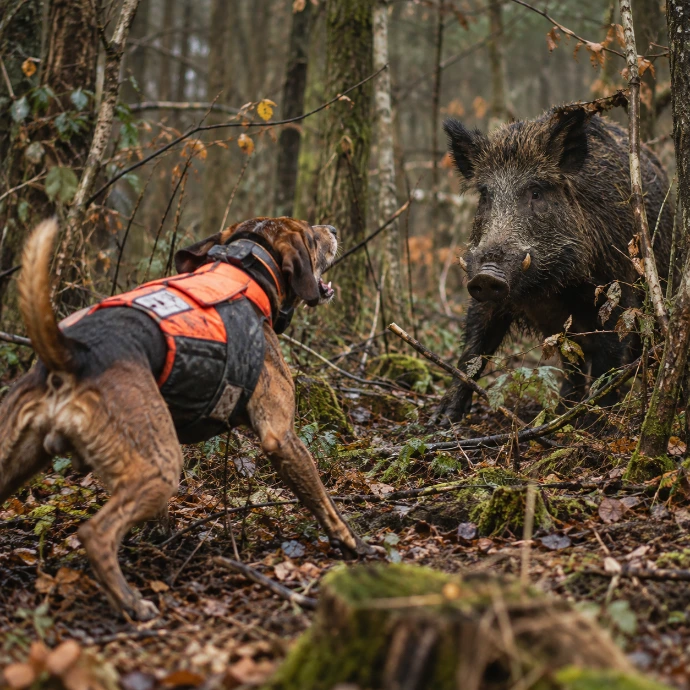
The main risk is where your dog works: in contact with wild boars..
Contamination can occur when a dog:
- bites an injured or dead wild boar;
- comes into contact with the saliva or secretions of an infected wild boar;
- eats contaminated viscera;
- consumes raw meat from an infected wild boar;
- licks or bites a carcass or waste from butchering.
The AFSCA particularly highlights the risk associated with carcasses, contaminated equipment, and meat or offal from infected wild boars.
An old reflex deserves to be abandoned: letting your dog "help itself" to the game after the kill.
Even if the wild boar seems perfectly healthy, this does not rule out the presence of the virus.
The dog on point: a situation that deserves particular vigilance
The work on point is one of the situations in which the dog can be confronted very directly with the wild boar.
Recent cases reported in Europe show that hunting dogs can develop the disease after being in close contact with wild boars.
This is also what makes prevention difficult: the normal behavior of a hunting dog can indeed lead it to take risks that we cannot completely eliminate.
The right approach is therefore to reduce unnecessary exposures, rather than imagining a hunt without contact with wildlife.
And in Belgium?
Yes. And it is important to distinguish between two situations.
Belgium has officially benefited from the status of free from Aujeszky disease for pig farms since 2011. Preventive vaccination of domestic pigs was stopped in 2009 and banned since January 1, 2011. No cases have been observed in domestic pigs since then.
It continues to circulate among wild boars.
Wallonia also recalled in January 2025 that several hunting dogs had died from the disease after contact with wild boars, particularly in the areas of Tellin, Mettet, and Houyet. The Walloon administration estimated at that time that about 30% of wild boars were carriers of the virus. Surveillance work conducted in Wallonia also confirms the circulation of the virus in wild boars.
In other words: " free " for pig farms does not mean " absent from our forests ".
Source: Public Service of Wallonia, Aujeszky disease in dogs and SPW Biodiversity, Aujeszky disease.
What are the symptoms in dogs?
The first signs may appear 2 to 6 days after contamination.
In an infected dog, one can notably observe:
- significant agitation or on the contrary great apathy;
- fever;
- significant salivation;
- neurological disorders, tremors, or spasms;
- stiffness of the neck;
- vomiting;
- especially, extremely intense itching, which can lead to true self-mutilation.
This intense itching is particularly evocative of Aujeszky's disease in dogs.
The progression is then extremely rapid. Death usually occurs within the 24 to 48 hours following the appearance of clinical signs. As soon as the symptoms appear, the prognosis is extremely bleak. There is no treatment that can cure a dog affected by Aujeszky's disease.
Warning: Aujeszky or rabies?
Some symptoms may suggest rabies. This is one of the reasons why the diagnosis must be made by a veterinarian.
A suspicion of Aujeszky should therefore be taken seriously, especially when a hunting dog has recently been in contact with a wild boar.
What to do if you suspect contamination?
There is there is no treatment that can cure a dog affected by Aujeszky's disease. In carnivores, the outcome is fatal.
If your dog shows concerning symptoms after a wild boar hunt:
1. Quickly contact your veterinarian: Explain to them precisely the context: wild boar hunting, contact with an injured or dead animal, possible consumption of offal or raw meat, and the date of contact.
2. Do not unnecessarily handle the dog: Avoid contact with the animal's secretions and follow the instructions given by the veterinarian.
3. Do not wait to see if the symptoms pass: The disease progresses very quickly.
4. Report the hunting context to the veterinarian: This information can be crucial for guiding the diagnosis.
In Belgium, Aujeszky's disease is one of the notifiable animal diseases. The AFSCA specifies that suspicions must be reported immediately to the competent Local Control Unit.
How to protect your dog during wild boar hunting?
There is no action that can completely eliminate the risk. The best protection remains prevention.
Prevent your dog from biting the game
When a wild boar is on the ground, avoid as much as possible that the dogs bite or lick the carcass.
This is particularly important during the cutting and evisceration.
Never give raw offal to the dog
The entrails and cutting waste should not become a reward for your assistant.
No raw wild boar offal, no raw meat from an animal whose health status is unknown.
Avoid unnecessary contact with carcasses
A dog that works on the farm can be very close to the wild boar. Prevention also starts with managing the game once the animal is controlled.
Also think about its equipment
Health protection is not the only reason to properly equip your dog.
A hunting dog can cross brambles, navigate rough terrain, and be exposed to the tusks of a wild boar.
A protective vest suitable can therefore complement your assistant's equipment, depending on their hunting style and the terrain.
It obviously does not protect against the Aujeszky virus: its role is the physical protection of the dog against the constraints of the terrain and the game.
The virus can also be transmitted indirectly through contaminated equipment. Managing clothing, boots, and gear is therefore important, especially to avoid transporting pathogens to other locations.
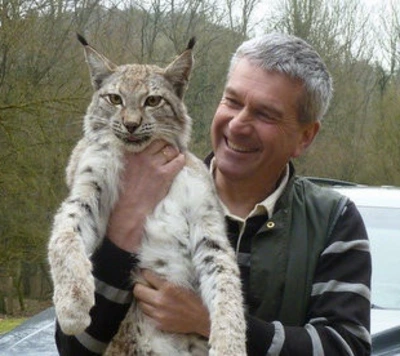
Dr. Olivier Bertrand
Doctor of Veterinary Medicine
Practice of Wildlife Medicine
Member of the General Assembly of the Veterinary Professional Union (UPV)
https://www.docveto.be/
The veterinarian's opinion
Can you vaccinate your dog against Aujeszky in Belgium?
In Belgium, there is currently no vaccine specifically marketed to protect dogs against Aujeszky disease. However, for dogs particularly exposed to wild boar, the question of vaccination deserves to be discussed with a veterinarian.
Dr. Olivier Bertrand, a veterinarian specialized in wildlife medicine, provides us with his insights on the possibilities considered in practice.
Is vaccination possible?
"An alternative may be considered by the veterinarian using an inactivated vaccine intended for pigs, within the regulatory framework applicable to the use of veterinary medicines without specific authorization in dogs.
The protocol I use consists of an initial vaccination of two injections spaced three weeks apart. The second injection is administered at least 15 days before the start of the risk period. A booster every six months is then recommended.
Caution: a live vaccine against Aujeszky's disease should never be used in dogs, as it can cause their death.
This vaccination must be evaluated and performed by a veterinarian."
Our advice: if your dog regularly works in contact with wild boars, discuss the topic with your veterinarian before the hunting season. They can assess their level of exposure, check regulatory possibilities, and determine if this approach is suitable for their situation.
Vaccination never replaces preventive measures or vigilance in the field.
A risk to be aware of, without falling into panic
Aujeszky disease is a serious issue for big game hunters, but the right response is not to avoid all outings with your dog.
It is mainly a matter of good reflexes.
Your dog is an integral part of your hunting. He sometimes works very close to the game and takes risks that you do not take yourself.
Knowing more about the diseases present in wildlife is also a way to better protect your helper.
And when it comes to Aujeszky, a simple rule is better than a thousand assumptions:
a wild boar that seems healthy is not necessarily a wild boar without the virus.
So, before the next hunt, think of your dog as you think of your own equipment: prepare, protect, and anticipate. 🌲🐗🐕
The 5 reflexes to remember
Pour résumer, si tu chasses le sanglier avec ton chien :
- 1. Ne laisse pas ton chien mordre ou manger les viscères du sanglier.
- 2. Évite autant que possible le contact avec les carcasses.
- 3. Ne donne jamais de viande ou d’abats de sanglier crus à ton chien.
- 4. Après un contact à risque, surveille attentivement son état dans les jours qui suivent.
- 5. En cas de symptômes suspects, contacte immédiatement ton vétérinaire et précise qu’il s’agit d’un chien de chasse ayant potentiellement été exposé au sanglier.
Valentin's perspective
What hunters can contribute to wildlife monitoring
We are among the people who spend the most time in contact with wildlife.
We see the animals, follow them, observe their condition, their behaviors, their movements. We are also present during the moments when an animal is harvested and its health status can be observed. This proximity gives us a responsibility.
Not to become veterinarians or scientists. But to to watch, to understand and to convey the right information.
An anomaly observed in an animal, a suspected case in a dog, unusual mortality: these are pieces of information that can be valuable for those monitoring wildlife health.
I am convinced that the hunting of tomorrow will need to work more with veterinarians, scientists, land managers, farmers, and other nature stakeholders.
We do not all have the same role. But we share the same territory.
And the better we know it, the better we can preserve it.
FAQ - Frequently Asked Questions
Yes. The virus circulates particularly in the populations of wild boars in Wallonia. Belgium, however, has been officially free of Aujeszky disease in pig farms since 2011.
Aujeszky disease is not considered a human zoonosis. The main concern involves certain animal species, particularly dogs and pigs.
Close contact with a wild boar increases the chances of exposure. Situations on the farm can particularly lead to bites or contact with the blood and secretions of the animal.
Cooking modifies the infectious risk, but to avoid any unnecessary exposure, it is better not to use offal or products whose health status is not controlled. If you have questions about your dog's diet with game, consult your veterinarian.
The first signs can appear a few days after exposure. The exact timing can vary, and the appearance of symptoms alone does not allow for a diagnosis.
No. Exposure depends particularly on the type of hunting practiced, the frequency of contact with wild boars, and how the dog works.
In the case of close contact, bites, injuries, or unusual exposure, it is advisable to consult your veterinarian and specify the hunting context.
No. This is an important distinction. The prevalence rate describes the proportion of positive animals in a studied population. The individual risk for the dog depends on its exposure and the circumstances of contact.
The hunter can contribute by reporting unusual situations, following health guidelines, and providing relevant information about wildlife and exposed dogs to the concerned professionals.
Not in itself. It mainly reminds us that hunting is part of a complex ecosystem. The health of dogs, that of wild boar populations, agricultural activities, land management, and wildlife monitoring are interconnected.
For The Hunter Camp, better understanding these interactions is part of a more responsible and sustainable approach to hunting.
Sources
Official sources
- SPW Biodiversity – Aujeszky disease in wild animals
- AFSCA – Aujeszky disease
- Order of veterinarians – New reporting tool for dogs (FR)
Scientific / academic research
- University of Liège – Work on Aujeszky disease in wild boar in Wallonia
- University of Liège – Study 2026 on Aujeszky disease in dogs in Belgium
Press and hunting media
- Chasse Passion – New reporting tool for Aujeszky disease in dogs (FR)
- Le Dauphiné Libéré – Aujeszky disease: what is this virus that kills hunting dogs? (FR)
- Labo-Terana – Resurgence of the disease in hunting dogs (FR)
- Chasse Passion – Case of Aujeszky disease detected in Corrèze (FR)
- Chasse Passion – Vaccination campaign for hunting dogs (FR)
- Landesjagdverband Mecklenburg-Vorpommern – Two hunting dogs dead from Aujeszky (DE)
- Landkreis Wittenberg – Danger for dogs and cats (DE)