![youtube - [Video]](/web/image/product.image/2289/image_128/youtube%20-%20%5BVideo%5D?unique=3a35a10)
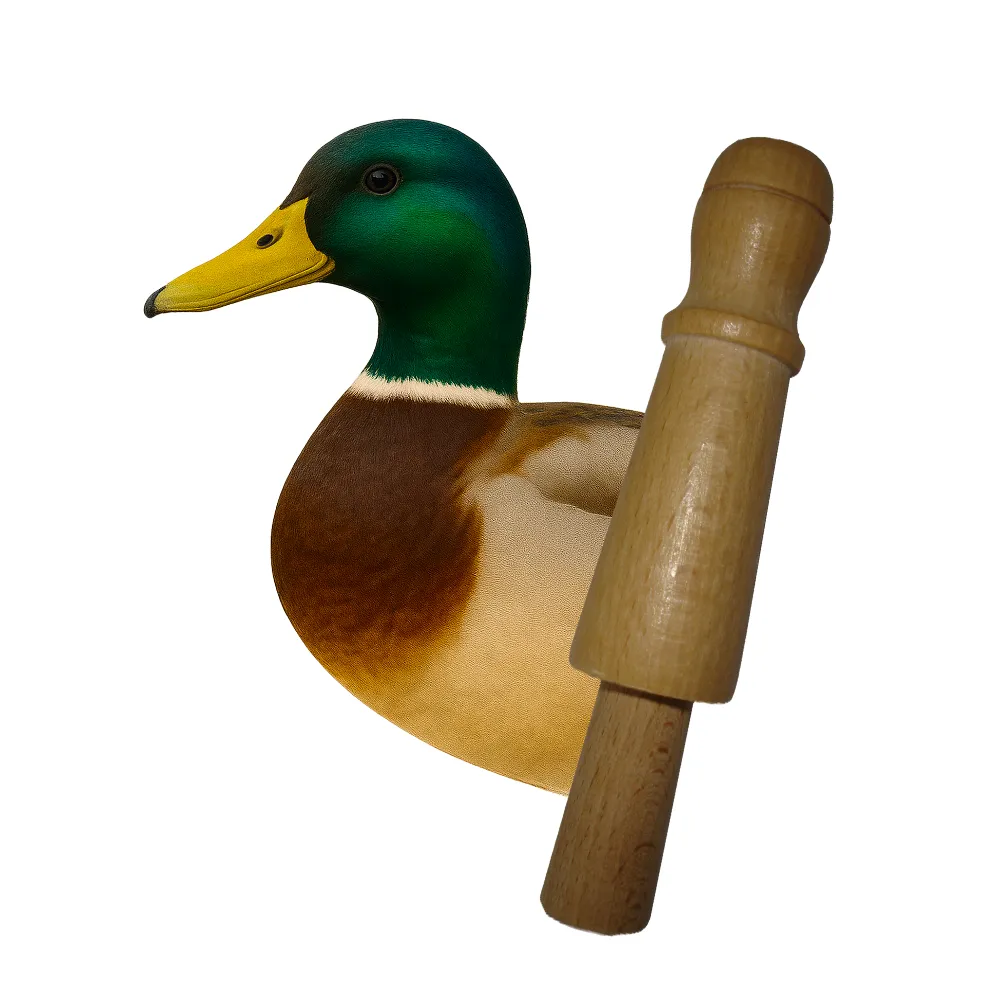
A call dedicated to the mallard duck
The Les Zapos Mallard Duck call is designed to specifically work on the mallard's call. It naturally finds its place in the equipment of the waterfowl hunter who wishes to be able to influence the behavior of the birds with a compact and readily available accessory.
The goal is simple: to reproduce the sounds of the mallard in a sufficiently controlled manner to integrate them into a real hunting situation.
For hunters
If you regularly hunt waterfowl, the call can become an interesting complementary tool. However, it requires training: the quality of the result depends as much on the hunter's technique as on the call used.
How to use the Les Zapos - Mallard call?
1
Learn how it works
Before using it in the field, take the time to understand how the call reacts to your breath. Start with simple and regular calls.
2
Work on the vocalizations
First, work at low intensity to control your breath and rhythm.
3
Adapt the call to the situation
Observe the birds and adjust the frequency and volume of your calls to the circumstances.
4
Use with moderation
An effective call remains a communication tool with the birds. The call should naturally fit into the situation rather than become systematic.
Why choose the Les Zapos - Mallard call?
A call dedicated to the mallard
The model is specifically designed to work on the vocalizations of the mallard.
.
A complementary accessory
It can complement your waterfowl equipment without taking up much space in your gear.
A tool to work on your technique
The call mainly allows you to progress in mastering breath, rhythm, and intensity.
A use directly oriented to the field
Its interest is measured in real situations: observation, listening to birds, and adapting the call.
Accessible to beginner hunters
A dedicated duck call can be a good entry point to discover call work, provided you take the time to practice.
A tool that allows for experience
As with many calling accessories, the result heavily depends on how the hunter uses it.

Valentin's opinion
I recommend it if you regularly hunt waterfowl and want to integrate call work into your hunting style. For me, a call should primarily be mastered before being used at full power in the field: I prefer a few clean calls that are suited to the situation.
This is typically the kind of accessory I would take when I know I will be able to observe birds and adapt my call accordingly.
FAQ - Frequently Asked Questions
It works with radios equipped with a Kenwood connector (2 pins).
Do not systematically try to increase the volume. Start by observing their behavior and trajectory. In some situations, reducing calls or stopping completely may be more relevant.
If the sound becomes forced, irregular, or lacks naturalness, your breath is probably too strong. Focus first on control and consistency rather than volume.
Humidity, water, or dirt can potentially disrupt the functioning of a call depending on its design. It is therefore important to follow the manufacturer's maintenance recommendations and check its condition before use.
No. The call is just the tool. Progress mainly comes from training, listening to the birds, and the ability to recognize situations in which to call or remain silent.
Yes, if the carrying system used is suitable. The benefit is being able to access the call quickly without interrupting your observation or movements.
This can be beneficial for a hunter looking for different species or wanting to have different sounds. To start, a specific call for the mallard already allows for working on a precise technique.
You might also be interested in these items
Discover our alternative or complementary products for hunting
&c4=o-color-4&c5=o-color-5)
Easy returns
Quick refunds or easy exchanges, with peace of mind.&c2=rgba(0,0,0,.5)&c4=o-color-4&c5=o-color-5)
Guaranteed shipping
Enjoy fast and secure delivery on all orders with no hidden fees.&c4=o-color-4&c5=o-color-5)
Secure payment
Your information is protected with secure payment and reliable payment methods.&c2=rgba(0,0,0,.5)&c4=o-color-4&c5=o-color-5)