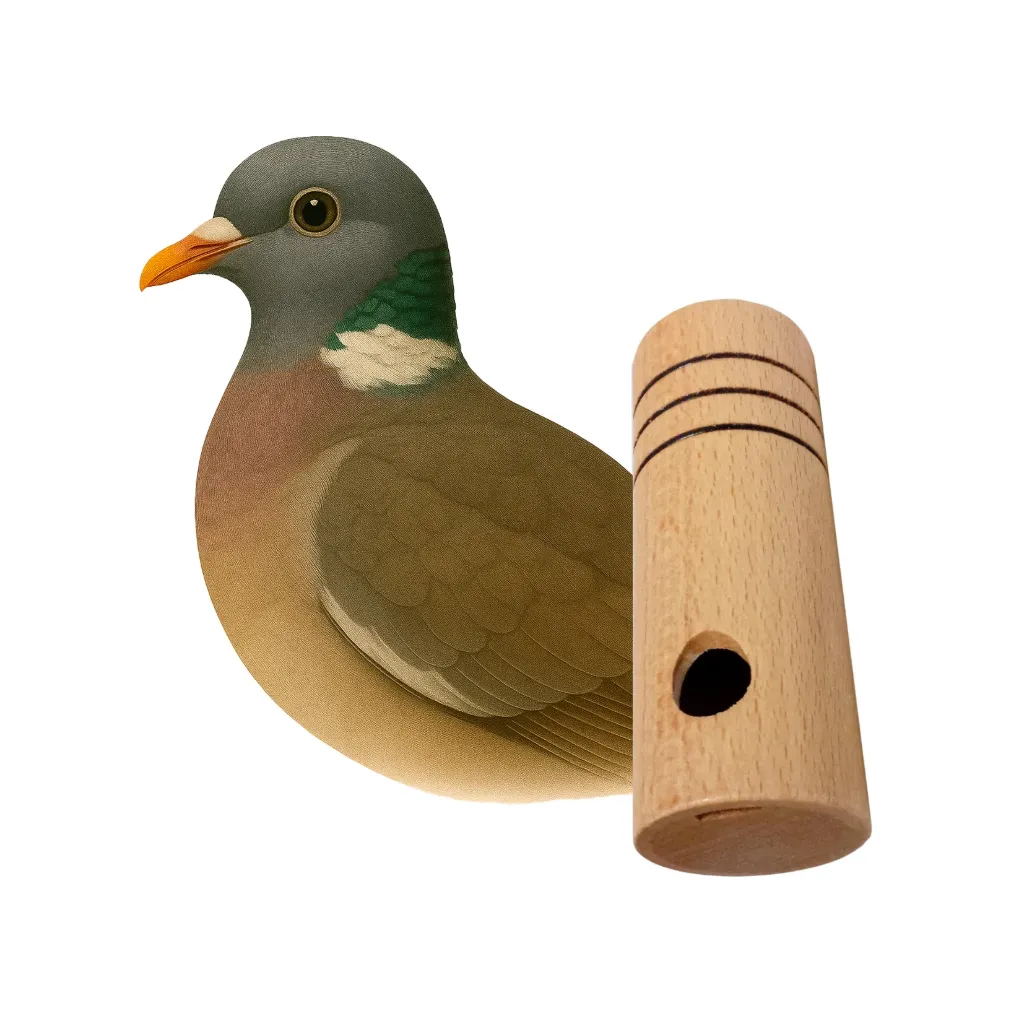
A call to work with the wood pigeon and turtle dove
The Hélen Baud Wood Pigeon & Turtle Dove call is intended to reproduce the vocalizations of two birds well known to hunters: the wood pigeon and the turtle dove. It can find its place in an approach or hide when calling is part of the strategy used.
The interest of such an accessory does not lie in a promise of systematic results. The behavior of birds depends on many parameters: wind, weather, hunting pressure, natural presence of birds, environment, and quality of imitation.
For hunters
If you regularly practice with the wood pigeon or the turtle dove and wish to have a dedicated call in your equipment, this model is an accessory to consider to complement your approach to the field.
How to use the wood pigeon/turtle dove call?
1
Before calling
Start by reading the terrain. Observe the presence of birds, their direction of movement, and their behavior before making multiple calls.
2
Stay discreet
Position yourself to limit visible movements. As with any acoustic caller, discretion is as important as the quality of the imitation.
3
Call
Use the call according to the technique intended for the Hélen Baud model. Work gradually rather than chaining calls without considering the birds' reactions.
4
Adapt
After each sequence, observe. If the birds react, adjust your rhythm and intensity. If nothing happens, there's no need to force it.
Why choose a wood pigeon and turtle dove call?
An accessory dedicated to two birds
The call is specifically oriented towards the wood pigeon and the turtle dove, allowing it to be integrated into equipment dedicated to these species.
Easy to integrate into your equipment
A call is an accessory that you can keep within reach during an outing without significantly weighing down your gear.
A complementary tool
It does not replace knowledge of the territory or observation. It complements a field strategy when conditions are favorable.
Call work
Regular use of a call also allows you to work on your imitation technique and gradually learn to adapt your sequences to the observed reactions.
Adapted to stalking situations
Its format and principle of use correspond particularly well to use from a position where the hunter can observe the reactions of the birds.
An approach based on observation
The call makes sense when used in moderation. The goal is to provoke a natural reaction, not to multiply calls without reason.

Valentin's opinion
I like this call for its simplicity. When I go for wood pigeons or turtledoves, it’s the kind of small accessory I prefer to have on me, especially when the birds are there and the situation lends itself to calling.
I recommend it to those who like to take the time to observe and play with the reactions of the birds, without overdoing it. In the field, you need to know when to call… but especially when to be silent.
FAQ - Frequently Asked Questions
The wood pigeon is the commonly used name for the wood pigeon in the context of hunting. This call is therefore intended to reproduce the vocalizations corresponding to this species.
No. It’s often the opposite: a few well-placed calls are better than repeated sequences without observing the birds' reactions.
Observe the birds' reactions. A change in trajectory, an approach, or on the contrary, a complete lack of reaction are all pieces of information. The idea is to adapt your call to the observed behavior rather than applying the same sequence every time.
There is no guarantee. Distance, wind, the bird's behavior, its attention, and its interest in the call all play a role. The call is a tool to provoke a reaction, not a bird remote control.
Overdoing it. A beginner hunter often tends to call more when they do not get a reaction. In the field, it is generally more interesting to call, wait, and observe before deciding what to do next.
After use, check its condition and let it dry properly if moisture has entered the mechanism. For specific cleaning or storage instructions, follow the manufacturer's recommendations.
The call is important, but technique, observation, and knowledge of the terrain remain essential. A good tool does not compensate for a poor reading of the situation.
You might also be interested in these items
Discover our alternative or complementary products for hunting
&c4=o-color-4&c5=o-color-5)
Easy returns
Quick refunds or easy exchanges, with peace of mind.&c2=rgba(0,0,0,.5)&c4=o-color-4&c5=o-color-5)
Guaranteed shipping
Enjoy fast and secure delivery on all orders with no hidden fees.&c4=o-color-4&c5=o-color-5)
Secure payment
Your information is protected with secure payment and reliable payment methods.&c2=rgba(0,0,0,.5)&c4=o-color-4&c5=o-color-5)