![youtube - [Video]](/web/image/product.image/2295/image_128/youtube%20-%20%5BVideo%5D?unique=5d3bc6d)
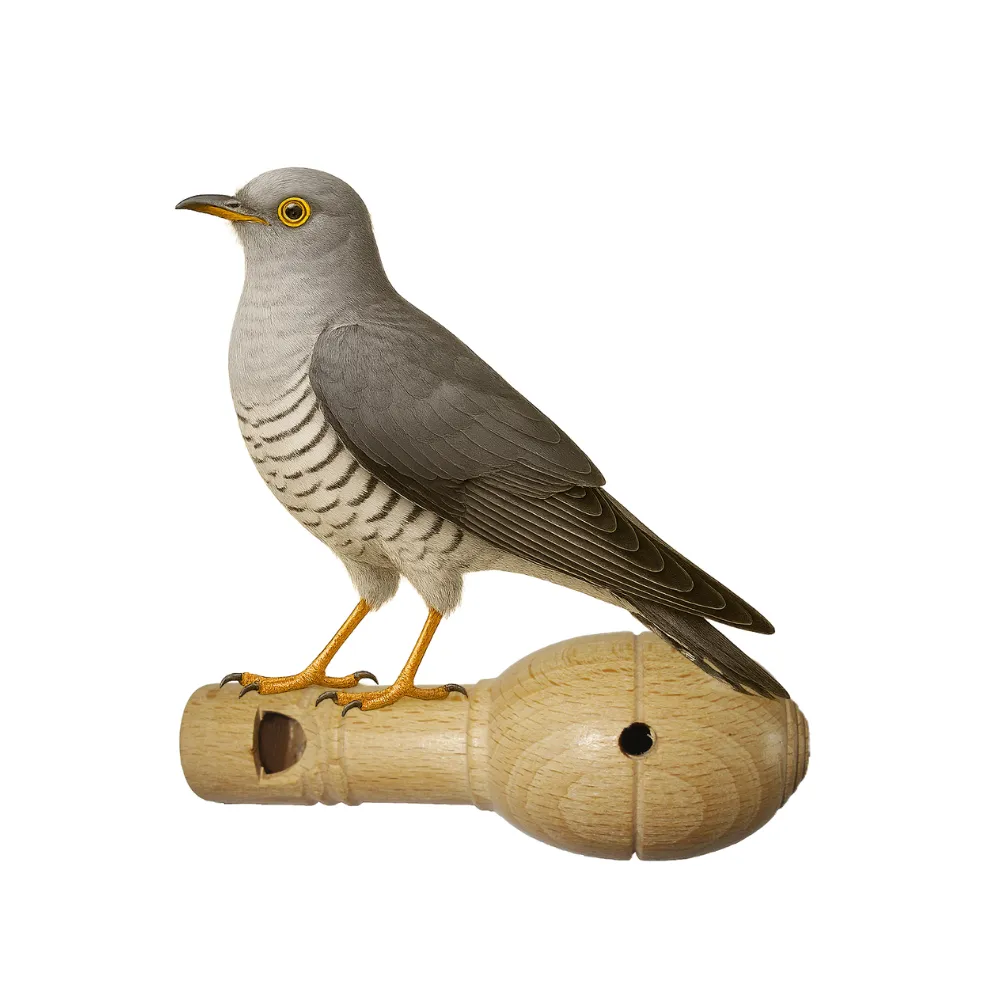
A specialized call to reproduce the Common Cuckoo
The Common Cuckoo is one of the birds whose song is immediately recognizable in the field. With the The Zapos Common Cuckoo call, the goal is to reproduce this sound signature in a way that is natural enough to integrate into an approach or observation session.
This type of call is mainly for those who want to work on their imitation and have a lightweight tool that is easily accessible during their travels.
For hunters
I see it as a field accessory, to take when imitating the song of the cuckoo may be of interest in the encountered situation. Its main advantage is its simplicity: compact, quick to deploy, and intended for precise use.
How to use the The Zapos - Common Cuckoo call?
1
Observe the field
Before blowing, take the time to listen to what is happening around you. Spot the birds present and identify the natural sounds already perceptible.
2
Choose the right moment
Avoid making multiple calls without reason. An imitation used in moderation blends better into the sound environment than a succession of calls.
3
Reproduce the song
Use the call by seeking a regular and natural emission. The quality of the imitation comes as much from the mastery of the gesture as from the tool itself.
4
Wait and observe
After the call, give it time. Observe and listen before starting again. In the field, patience often allows for a better understanding of the environment's reaction.
Why buy the Les Zapos - Gray Cuckoo call?
A targeted sound imitation
The call is specifically designed to reproduce the song of the gray cuckoo. You therefore have a tool suited for a specific use rather than a general call.
An easy-to-carry accessory
A call takes up little space in the equipment. It can remain accessible in a pocket or with the rest of the field gear.
Immediate use
No need for complex installation. The interest of a call of this type lies precisely in its availability when the situation arises.
A tool to work on your approach
The call can also help improve your mastery of sounds and your behavior in the field: listen, imitate, wait, and analyze reactions.
An approach based on observation
The use of a call encourages paying attention to the sound environment. This is particularly interesting for someone who wants to better know their territory.
A complement to field equipment
It does not replace other equipment. It complements a set when the sound call has a utility in the encountered situation.

Valentin's opinion
I like calls that have a clearly defined function. I would recommend it to a hunter or enthusiast who wants to work on imitating the common cuckoo and keep a simple accessory on them.
In this type of use, my field experience mainly leads me to prioritize the accuracy of the call and the right moment rather than multiplying the solicitations.
FAQ - Frequently Asked Questions
The quality of the result depends on the mastery of the call and the way the sound is produced. It is better to start by working on the imitation in a calm environment.
Not necessarily. Breath control and the regularity of the emission are more important than power.
You should mainly consider the actual presence of the species, the observed activity, and the sound environment. The use must remain consistent with the field situation.
This model is designed to reproduce the common cuckoo. To imitate other species, you need to use a call designed for the corresponding song.
The maintenance depends on the material and the exact design of the model. After use, it is recommended to let it dry properly and to follow the manufacturer's instructions.
As with any call, it is best to avoid leaving it wet or enclosed immediately after use. Let it dry properly and follow the manufacturer's maintenance recommendations.
You might also be interested in these items
Discover our alternative or complementary products for hunting
&c4=o-color-4&c5=o-color-5)
Easy returns
Quick refunds or easy exchanges, with peace of mind.&c2=rgba(0,0,0,.5)&c4=o-color-4&c5=o-color-5)
Guaranteed shipping
Enjoy fast and secure delivery on all orders with no hidden fees.&c4=o-color-4&c5=o-color-5)
Secure payment
Your information is protected with secure payment and reliable payment methods.&c2=rgba(0,0,0,.5)&c4=o-color-4&c5=o-color-5)