
Why this equipment is essential
Binoculars: your best ally in the field
When preparing your equipment, you naturally think of the rifle, the scope, the clothing, or even the shoes. Binoculars often come at the end of the list, seen as just an accessory. However, it only takes spending a day with a gamekeeper or an experienced hunter to understand one thing: binoculars are often used much longer than the weapon itself.
A good pair of binoculars accompanies you from the very first moments of the outing. It allows you to observe an edge without disturbing the game, to monitor movement in a field, to identify an animal even before considering a move, and, above all, to avoid mistakes that could compromise the entire day of hunting.
Observing earlier, observing longer, and observing with greater precision represents a real advantage in the field. This is precisely why experienced hunters place so much importance on the quality of their binoculars.
Understanding the numbers
What does 8x42 mean on a pair of binoculars?
These four characters summarize a large part of the binoculars' performance.
8
The magnification
Indicates how many times the image is enlarged
x
42
The diameter of the objectives
Corresponds to the diameter of the
front lenses in millimeters.
The higher the number,
the more light they capture.
These 2 pieces of information influence:
- Brightness
- Observation comfort
- Weight
- Image stability
- Field of view
But contrary to popular belief, a higher number doesn't automatically mean better binoculars.
The 5 essential criteria
Magnification: Why more isn't necessarily better
This is probably the most common mistake.
Many hunters think that a magnification of 12 or 15 is necessarily better than a magnification of 8. In the field, the reality is quite different.
The more the magnification increases, the more every movement of your hands is amplified. A slight vibration quickly becomes an unstable image, tiring to observe for several minutes.
In addition, there is a decrease in the field of view. You can see further, certainly, but you observe a much smaller portion of the landscape. Finding an animal then becomes more difficult, especially when it moves quickly between trees or in dense vegetation.
That is why hunters who spend several dozen days a year in the field generally prefer more reasonable magnifications.
The 8x42 binoculars: now considered the most versatile
It offers:
- a very stable image;
- a wide field of view;
- excellent brightness;
- reduced eye strain;
- remarkable comfort during long observations.
Whether you practice driven hunting, stalking, or waiting, the 8x42 adapts to almost all situations.
10x42 binoculars appeal to hunters seeking greater detail.
They allow for better distinction of distant animals while maintaining a relatively light weight.
On the other hand, they require a bit more stable observation and offer a slightly reduced field of view.
2. The diameter of the objective: why is it so important?
The second number corresponds to the diameter of the front lenses. The larger they are, the more light they capture. And in hunting, light is a precious resource.
The best observation moments often occur:
- just before sunrise;
- in the last minutes of twilight ;
- in dense forest ;
- in overcast weather.
In these conditions, a bright pair of binoculars makes a huge difference.
Quality optics allow you to distinguish details that entry-level binoculars will completely leave in the shadows.
Lens quality: The deciding factor
The quality of a pair of binoculars does not depend solely on its magnification or the diameter of its objectives. The type of glass used also plays an essential role in sharpness, contrast, and viewing comfort. That’s why you will often encounter the terms classic glass, ED, or HD on the technical specifications.
| Classic glass | ED glass | HD glass | |
|---|---|---|---|
| Sharpness | ★★☆☆☆ | ★★★★☆ | ★★★★★ |
| Color fidelity | Correct | Very good | Excellent |
| Contrasts | Medium | High | Very high |
| Chromatic aberrations (colored fringes) | Visible | Reduced | Almost nonexistent |
| Low light performance | Average | Good | Excellent |
| Price | € | €€ | €€€ |
Classic glasses
Binoculars equipped with classic glasses are perfectly suitable for a casual use or during the day. They offer a correct image, but their limits appear when brightness decreases or contrasts are significant. It is not uncommon to observe slight colored fringes around silhouettes or a loss of precision on the finest details.
ED (Extra-low Dispersion) lenses
ED lenses use very low dispersion glass that reduces chromatic aberrations. In practice, the image is sharper, colors are more accurate, and contours remain precise, even in difficult lighting conditions.
This difference becomes particularly visible :
- at sunrise ;
- at twilight ;
- when game blends in with the vegetation.
Once you have observed through quality ED binoculars, it is often difficult to return to classic optics.
HD (High Definition) lenses
Unlike ED lenses, the term HD does not correspond to a specific technology. It is a commercial designation used by many manufacturers to refer to binoculars that offer superior image quality.
Depending on the brands, this improvement may come from better lens treatment, more efficient prisms, optimized light transmission, or even... integrated ED glass.
Field of view: An often overlooked criterion
The field of view corresponds to the width of the visible terrain at a given distance.
The wider it is:
- the easier it is to spot an animal;
- the tracking becomes more natural;
- the searches are less tiring.
In a drive, in particular, a large field of view provides unmatched comfort.
The weight of binoculars matters more than you might think
In the catalog, 150 grams seem insignificant. After eight hours of hunting, it's a different story.
Too heavy binoculars often stay in the bag.
Comfortable binoculars stay around the neck. And those are the ones that actually get used.
Should you buy high-end binoculars?
It's a question of frequency of use.
If you go out two or three times a year, a mid-range pair can be perfectly suitable.
On the other hand, if you hunt regularly, investing in excellent optics is probably one of the most cost-effective purchases you can make.
Good binoculars will accompany you for ten, fifteen, or even twenty years.
The cost relative to the number of outings ultimately becomes very low.
What budget should be planned for good binoculars?
The market today covers a wide range of prices.
- Less than 200 € : suitable for occasional use, with compromises on optical quality.
- Between 300 and 700 € : the best balance for the majority of hunters, with already very convincing performance.
- Beyond 1,000 € : high-end optics offering exceptional comfort, particularly appreciated by intensive users.
Rather than aiming for the most expensive model, it is often wiser to choose a pair that truly matches your usage.
What format according to your practice?
Choose your binoculars according to your type of hunting
Your main practice | Ideal for... | Recommended format |
Beating | Quickly observing the movements of game at short and medium distances, with a wide field of view. | 8x42 |
Stalking | Alternating observations at medium and long distances while remaining mobile. | 8x42 or 10x42 |
Hide | Observing animals often far away for longer periods with greater precision. | 10x42 |
Mountain hunting | Spotting game at great distances in open landscapes. | 10x42 or 10x50 |
Dusk observation | Maximizing brightness when animals are most active at dawn or dusk. | 10x50 |
Long-distance observation | Observing animals at very long distances from a fixed position. | 15x50 with tripod |
Still hesitating?
If you only want to invest in a single pair of binoculars for practicing multiple hunting modes, the 8x42 remains the best compromise. They offer an excellent balance between brightness, field of view, weight, and versatility. For hunters who mainly spend their time waiting or in the mountains, the 10x42 often represents a better choice due to their higher magnification.
Product review by a hunter
Why Valentin uses the GPO Passion ED 8x42
At The Hunter Camp, we test products in real conditions.
Valentin uses the GPO Passion ED 8x42, not because they have the most impressive technical specifications, but because they perfectly meet the demands of the field.
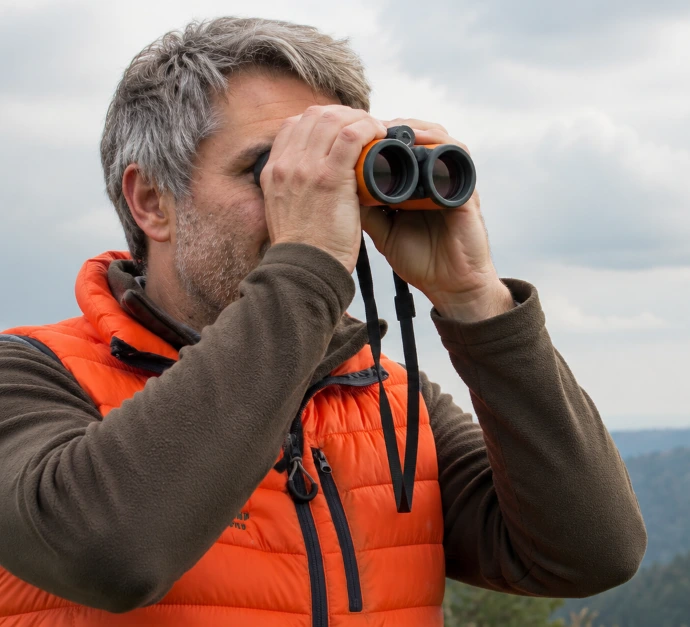
Valentin uses the GPO Passion ED 8x42, not because they have the most impressive technical specifications, but because they perfectly meet the demands of the field.
"I often spend more time observing than shooting. So I need binoculars that I can use for hours without fatigue. The Passion ED offers an extremely sharp image, even when the light decreases. They are compact enough to stay around my neck all day, and their optical quality rivals much more expensive models. It's simply the pair that accompanies me everywhere."
This feedback perfectly illustrates what most hunters are looking for: a reliable, bright, and versatile pair that can keep up with them in any conditions.
The mistakes most hunters make when making their first purchase
Before concluding, here are the most common pitfalls:
- choosing the highest magnification available;
- neglecting the quality of the lenses;
- buying binoculars that are too heavy;
- underestimating the importance of the field of view;
- prioritizing price over observation comfort.
A good pair of binoculars is an investment. It's better to buy one excellent pair that will accompany you for years than to replace several of average quality.
Our advice
If you could only remember one recommendation, it would be this: prioritize a pair of 8x42 equipped with ED lenses. This format offers the best balance today between brightness, stability, comfort, and versatility. It is the one that will suit the vast majority of hunters, regardless of their experience and hunting style.
At The Hunter Camp, we only select binoculars that we would use ourselves in the field. Rather than multiplying references, we prioritize proven models that offer an excellent compromise between optical quality, robustness, and budget. If you are hesitating between several models, our team can also help you choose the binoculars that are best suited to your practice.
FAQ - Frequently Asked Questions
There is not a single "best" pair of binoculars, but a model suited to each practice. For versatile use, 8x42 binoculars are generally considered the best compromise between brightness, stability, and comfort. Hunters primarily practicing stalking or long-distance observation will appreciate 10x42 or 10x50 models more.
The first number (8) indicates the magnification: the image appears eight times closer than with the naked eye. The second number (42) corresponds to the diameter of the objectives in millimeters. The larger this diameter, the more light the binoculars capture, which improves performance at dawn and dusk.
The 8x42 are ideal for versatile use. They offer a stable image, a wide field of view, and excellent observation comfort. The 10x42 allow for observing more details at long distances, but require better stability and offer a slightly reduced field of view.
For the majority of hunters, a magnification of 8x or 10x is the most suitable. Beyond that, vibrations become more noticeable and handheld observation is more difficult. Magnifications of 12x or more are primarily intended for very long-distance observations with a tripod.
Yes, especially if you hunt regularly at dawn or dusk. ED (Extra-low Dispersion) lenses reduce chromatic aberrations and improve sharpness, contrast, and color fidelity. They provide real comfort in observation under the most demanding light conditions.
For regular use, it is generally advised to budget between 300 and 700 €. In this price range, it is possible to find binoculars offering excellent optical quality, good durability, and lasting comfort. High-end models often exceed 1,000 €, but represent a long-term investment.
Yes. Binoculars intended for hunting must be able to withstand rain, fog, humidity, and temperature variations. Quality waterproofing also protects the optical elements from dust and extends their lifespan.
Hunting binoculars generally prioritize brightness, durability, waterproofing, and low-light performance. Hiking binoculars are often more compact and lighter, but sometimes less effective when conditions become challenging.
To fully enjoy their performance, it is advisable to adjust the interpupillary distance as well as the diopter correction according to your vision. A good adjustment significantly improves comfort and image sharpness.
Always clean the lenses with a blower or a soft brush before using a microfiber cloth. Avoid classic fabrics or paper, which can scratch optical coatings. After being out in the rain, let the binoculars dry naturally before storing them in their case.
A quality pair of binoculars can accompany a hunter for twenty years or more, provided they are properly maintained. The best models are designed to withstand shocks, moisture, and heavy use.
No. Optical binoculars provide a natural, highly detailed, and true-to-color image. A thermal camera detects the heat of animals, even in darkness or dense vegetation. These two pieces of equipment are complementary and serve different needs.