
Fruitfulness of forests, climate change, agriculture, milder winters… Several natural and environmental factors explain today the progression of the wild boar. So, what is really the responsibility of feeding? Analysis.
"If there are so many wild boars, it's because hunters feed them and release them."
This statement regularly comes up in discussions about big game management. It is simple, easy to understand, and points to a clear culprit: the hunter.
But when we take the time to examine the numbers, compare territories, and consult scientific studies, the conclusion deserves to be nuanced.
Because wild boars are also increasing in regions where feeding is prohibited, in countries where releases have been banned for several years, and even in urban areas where hunting is not practiced.
Feeding can locally influence the behavior and distribution of wild boars. But can it, by itself, explain their spectacular progression in Europe? The available data shows that it cannot.
1. The wild boar population is increasing throughout Europe
The expansion of the wild boar population is not a phenomenon unique to Wallonia or Belgium; it affects a large part of the European continent.
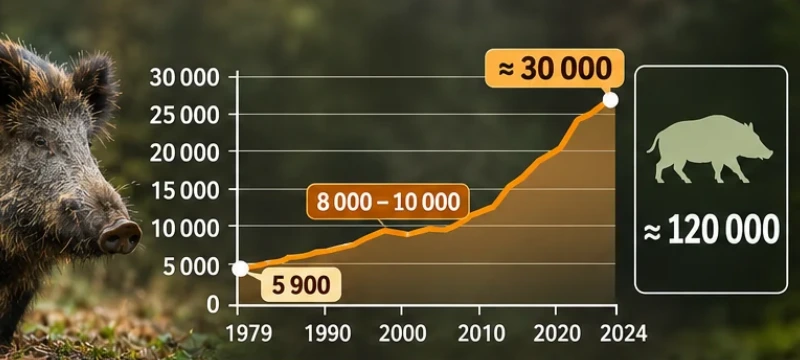
In Wallonia, the number of wild boars culled rose from approximately 5,900 in 1979 to between 8,000 and 10,000 in the 1990s. Today, the figure approaches 30,000 animals per season, from a population estimated at around 120,000 individuals before the start of the hunting season.
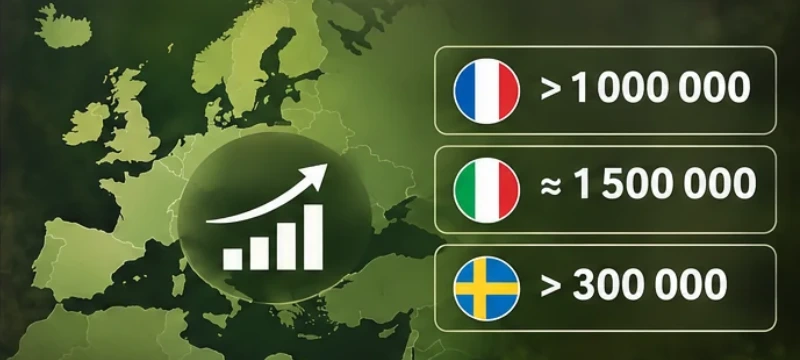
This trend is also observed in our neighboring countries:
In France, over one million wild boars were harvested during the 2025-2026 season, a record level according to figures reported by the French Office for Biodiversity.
In Italy, the harvests reached about 1.5 million wild boars according to national data from ISPRA.
In Sweden, the harvests exceed 300,000 animals.
A scientific study published in 2015 covering 18 European countries had already highlighted a widespread increase in wild boar populations since the 1980s (Massei et al., 2015).
More recently, a comparative study covering 16 European countries observed a synchronization of population variations across much of the continent (Hagen et al., 2026). This last finding is particularly interesting.
Regulations regarding feeding vary greatly from country to country. Yet, populations are experiencing similar trends. This suggests the existence of large-scale common factors that far exceed local feeding practices.
2. Acorns, beechnuts, and climate: the true drivers of wild boar reproduction
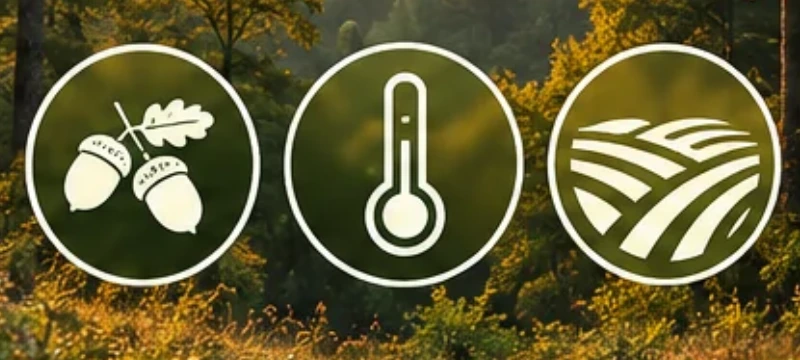
To understand the evolution of populations, one must start by looking at what is happening in the forest.
The wild boar is an opportunistic animal. Its diet is very varied, but acorns and beech mast are particularly important resources, especially at certain times of the year.
These forest fruits, produced respectively by oaks and beeches, play an essential role in the physical condition of the animals.
Years of high fruiting favor reproduction.
When oaks and beeches produce a lot of fruit, wild boars have access to a particularly interesting energy-rich food resource.
The consequences are significant:
Sows can improve their physical condition.
Some females reach the necessary conditions for reproduction more quickly.
The reproduction rate can increase.
Young ones have better conditions for survival.
A French study dedicated to the dynamics of wild boar populations notably showed the determining influence of acorn production.
According to the demographic model studied by Touzot and his collaborators in 2020, high fruiting can allow for a population growth of about 20% per year, with constant hunting pressure, while the population remains stable in the absence of acorns.
In other words, a good acorn crop can have considerable consequences on the dynamics of a population.
Walloon data confirms this trend.
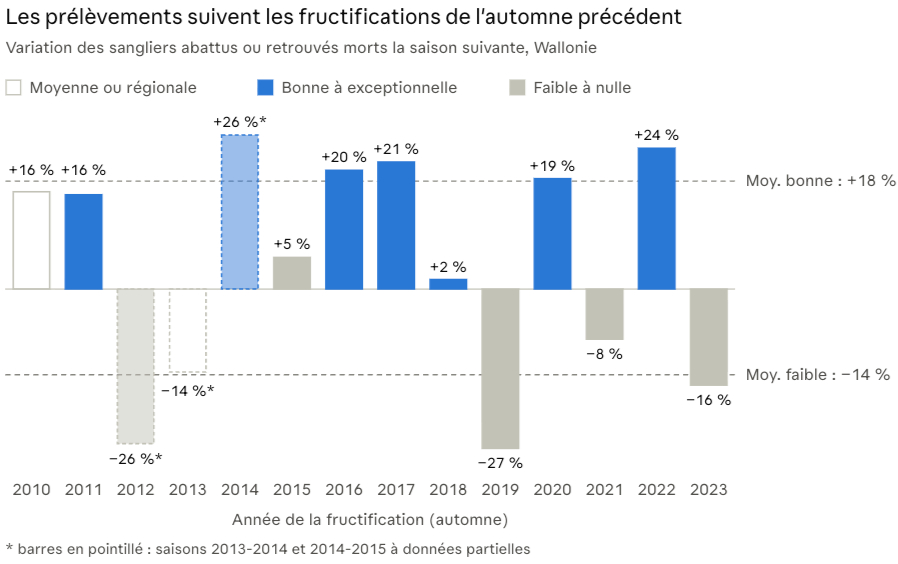
Official data from the Walloon Public Service (SPW) highlights a relationship between forest fruiting and wild boar harvests.
After a good fruiting, the harvests of the following season increase on average by 18%.
After a poor fruiting, they decrease on average by 14%.
This variation is statistically significant according to the analysis conducted.
This is an important element for understanding the annual fluctuations of populations: natural food resources can cause significant variations, regardless of feeding practices.
Climate change also favors the wild boar.
Climate evolution is another factor to consider.
In Belgium, the average temperature has increased by about 1.9 °C since 1890. Since 1981, the number of frost days has also decreased, by about five days per decade, according to climate data provided by the SPW and the IRM.
These developments have several consequences for the wild boar:
Warmer springs can favor certain forest fruiting.
Higher summer temperatures change the frequency of years with high production of beech mast.
Milder winters reduce climate constraints for young animals.
Better survival of piglets can contribute to increasing populations.
The Walloon Government had already linked, in an order dated December 21, 2022, abundant fruiting, an exceptionally mild climate, and a high reproduction rate of the wild boar.
The climate and natural food resources are therefore not just simple contextual elements. They directly participate in the dynamics of populations.
3. Wild boars also increase where feeding is prohibited
This is one of the most interesting elements of the debate.
If feeding were essential for population growth, we should logically observe a stabilization in regions where this practice is prohibited.
However, several European examples show exactly the opposite.
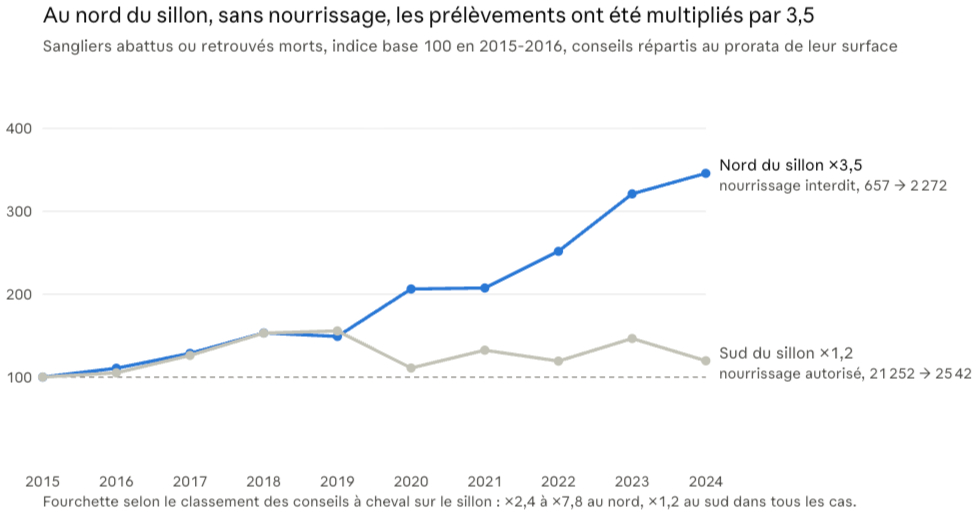
In the north of the Sambre-Meuse valley: a progression despite the ban
In Wallonia, feeding of large game has been prohibited north of the Sambre-Meuse valley since 2012.
Yet, the harvest of wild boars there has multiplied by about 3.5 between 2015 and 2024.
In the south of Wallonia, where deterrent feeding was allowed, they have multiplied by about 1.2 over the same period.
It is obviously necessary to take into account the starting differences between the two territories, as well as the intensification of hunting pressure in the south since the appearance of African swine fever in 2018.
But the observation remains interesting: a population of wild boars can experience strong growth in a region where feeding is prohibited.
Why? Part of the answer lies in the agricultural landscape.
In the north of the Sambre-Meuse valley, about 80% of agricultural land is dedicated to crops, notably cereals, corn, beets, and potatoes. Pastures represent about 17% of the area.
In the south, the prairies represent about 61% of agricultural land. The large crops provide wild boars with particularly interesting food resources and refuge areas.
The agricultural landscape therefore directly contributes to the attractiveness of a territory.
In Flanders: a progression without common feeding
In Flanders, feeding wild boars is sanctioned and is not a common practice according to information attributed to a researcher from INBO, the Flemish Institute for Nature and Forest Research.
However, since the return of the wild boar in 2006, populations have progressed rapidly.
A university study from 2022 estimates this growth at about 37% per year over the studied period.
Again, the expansion of the species cannot therefore be attributed solely to feeding.
In Italy: rising populations despite prohibitions
Italy provides another interesting example. Since February 2016, feeding and releasing wild boars have been prohibited throughout the territory under national legislation.
However, between 2015 and 2021, the harvests increased by 45% according to data from ISPRA.
These examples do not demonstrate that feeding has no effect. They show something more precise: it is not necessary for the development of a wild boar population.
4. Why are wild boars increasingly found in cities?
Wild boars no longer only frequent large forests and hunting grounds. They are now observed near homes, in green spaces, parks, and even in some urban centers.
Namur, Liège, Seraing, and the outskirts of Brussels also experience sightings of wild boars.
This phenomenon is not exclusively Belgian. In Barcelona, over 3,000 wild boars have been observed in urban areas over a period of four years, according to a study published in 2017. In Berlin, regularly watered lawns, gardens, and composts provide interesting resources.
Why are these animals getting closer to cities? The answer mainly lies in three elements:
Food: food waste, food intended for pets, composts, and vegetation in green spaces.
Tranquility: some urban areas offer refuges where animals are less disturbed.
Proximity to natural habitats: green spaces and ecological corridors facilitate their movements.
Geneva, an interesting case to understand the phenomenon.
Since 1974, hunting has been prohibited following a popular decision. Therefore, there are no hunters who practice feeding or releasing wild boars in the cantonal territory.
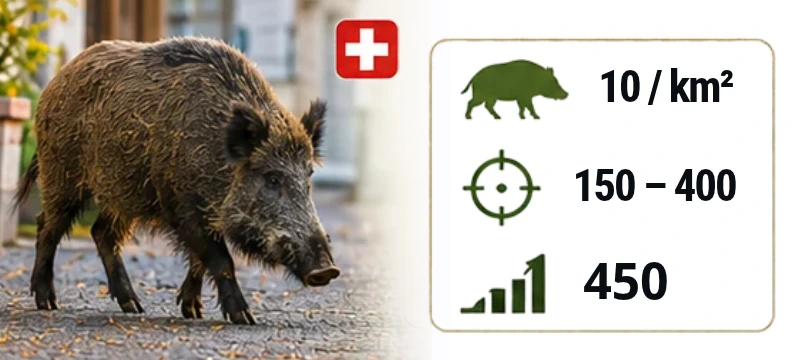
Nevertheless, wild boar populations have reached significant densities in the region. In the early 2000s, densities of approximately 10 animals per square kilometer were reported in certain areas.
Population management is ensured by state environmental guards, who carry out regulation shootings.
Annual culls of 150 to 400 animals have been reported, with a record announced of 450 animals in 2025-2026.
A study conducted by the HEPIA higher education institution also tracked the movements of a sow equipped with a GPS. The animal frequented an urban area during the hunting season.
An important clarification: part of the wild boar present in the canton comes from France, where hunting pressure may encourage them to seek refuge on the other side of the border.
But this example illustrates an essential point: wild boar populations can settle and maintain themselves in territories without feeding practiced by hunters.
5. Do the releases of wild boar explain their proliferation?
It would be inaccurate to claim that releases of wild boar have never existed.
In Belgium, imports and releases did indeed occur in the past. Their prohibition dates back to 1994.
A genetic study involving more than 1,250 Walloon wild boars estimated that about 5% of the animals had a foreign origin.
But it is necessary to distinguish two things: the history of the introduction of certain populations and the mechanisms that explain their current growth. Releases made before 1994 are not sufficient to explain a progression that continues several decades after their prohibition.
The case of hybrids between domestic pigs and wild boars, sometimes referred to as "cochongliers," also deserves to be put into perspective. A genetic study published in 2013 estimated the proportion of recent hybrids in northwestern Europe to be around 4%.
These crossings exist, but they do not constitute a general explanation for the increase in populations.
6. Is feeding wild boars without consequence?
No. And this is precisely where we need to make the distinction between two statements.
- Saying that feeding can influence a local population is correct.
- Saying that it alone explains the explosion of wild boar populations in Europe is much more difficult to defend in light of the available data.
Feeding can have several effects:
Concentrate animals in specific areas.
Modify their movements and eating habits.
Locally favor their maintenance in a territory.
Increase contacts between individuals.
Increase certain health risks related to the concentration of animals.
It is notably for these reasons that scientists recommend limiting or banning certain feeding practices.
Alain Licoppe, a scientist at the Department of Natural and Agricultural Environment Study (DEMNA) of the Public Service of Wallonia, does not advocate for feeding. He recommends its prohibition as a precaution, particularly due to the risks of animal concentration and disease spread. However, he considers its influence to be anecdotal compared to the amount of food naturally available in the forest, according to an interview published by Médor in 2018.
This distinction is essential: recognizing the possible effects of feeding does not mean attributing it the main responsibility for population dynamics.
7. Hunters are always taking more wild boars.
Another idea regularly comes up in debates: if populations are increasing, it would be because there are no longer enough hunters to regulate them.
Là encore, les chiffres wallons apportent un éclairage intéressant.
- Le nombre de permis de chasse validés en Wallonie était d'environ 16 000 par an jusqu'en 2010.
- En 2021-2022, il atteignait 19 367, un record selon les chiffres relayés par la RTBF.
- Parallèlement, les prélèvements de sangliers ont fortement augmenté.
- Chaque chasseur prélève aujourd'hui environ 2,5 fois plus de sangliers qu'au cours des années 1990
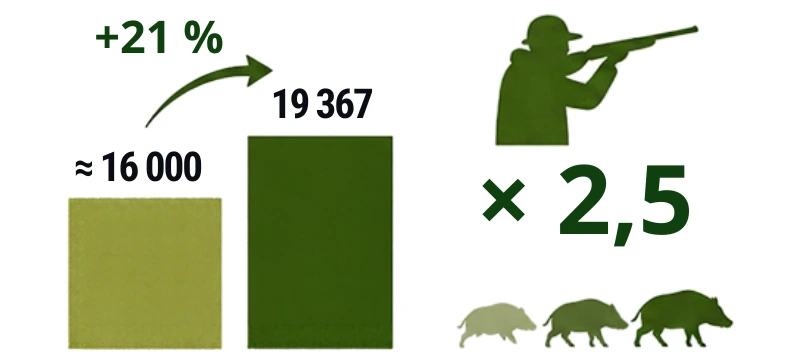
L'effort de chasse s'est donc intensifié.
Cela ne signifie pas que la chasse suffit à elle seule à réguler les populations, ni qu'elle ne doit pas évoluer. Cela montre simplement que la progression du sanglier ne peut pas être expliquée par un manque général de chasseurs.
Lorsque les conditions naturelles favorisent fortement la reproduction et la survie des jeunes, la capacité de régulation rencontre ses propres limites.
8. Alors, quelle est la véritable cause de l'augmentation des sangliers ?
Il n'existe pas une seule cause à la progression des populations de sangliers.
Plusieurs facteurs se combinent et peuvent se renforcer mutuellement :
1. Les fructifications forestières
Les années de forte production de glands et de faines améliorent les ressources alimentaires disponibles et favorisent la reproduction.
2. Le réchauffement climatique
Des hivers plus doux augmentent les chances de survie des marcassins et modifient les conditions de fructification des arbres.
3. L'évolution des paysages agricoles
Les cultures comme le maïs, les céréales, les betteraves et les pommes de terre fournissent nourriture et refuge.
4. L'adaptabilité du sanglier
Omnivore, mobile et opportuniste, le sanglier est capable de tirer parti de milieux très différents, des grandes forêts aux zones périurbaines.
5. Le nourrissage et les activités humaines
Ils peuvent modifier localement la répartition des animaux, leur comportement et leur concentration. Ils doivent donc être pris en compte dans la gestion des populations, sans être confondus avec les facteurs qui expliquent leur expansion à grande échelle.
Conclusion : le nourrissage n'explique pas à lui seul la prolifération des sangliers
Le nourrissage des sangliers mérite un encadrement sérieux. Ses excès peuvent avoir des conséquences sur les comportements des animaux, leur concentration et les risques sanitaires.
Mais les données européennes montrent qu'il ne constitue pas une condition nécessaire à l'augmentation des populations.
Les sangliers progressent dans des territoires où le nourrissage est interdit, dans des pays où les lâchers sont prohibés et jusque dans des villes où les chasseurs ne pratiquent aucune activité.
Les principaux facteurs à prendre en compte sont ailleurs : les fructifications forestières, le réchauffement climatique, la douceur des hivers, les ressources alimentaires agricoles et l'adaptabilité remarquable de cette espèce.
Comprendre la progression du sanglier demande de regarder l'ensemble de son environnement, et pas seulement les pratiques des chasseurs.
Accuser systématiquement le nourrissage ou les lâchers ne permet pas de comprendre le phénomène. Et surtout, cela risque de détourner l'attention des véritables enjeux de gestion des populations.
Chez The Hunter Camp, nous pensons qu'une gestion responsable du grand gibier commence par une bonne compréhension de l'animal, de son milieu et des données scientifiques disponibles.
Parce qu'avant de chercher un responsable, encore faut-il comprendre ce qui se passe réellement sur le terrain.
FAQ - Questions fréquentes sur le nourrisage des sangliers
Non, pas à lui seul. Le nourrissage peut favoriser localement le maintien et la concentration des animaux, mais la progression des populations en Europe s'explique aussi par les fructifications forestières, les hivers plus doux, le réchauffement climatique et les ressources agricoles.
Plusieurs facteurs se combinent : les bonnes glandées et fainées, des conditions climatiques plus favorables à la survie des marcassins, des ressources alimentaires agricoles abondantes et la grande capacité d'adaptation du sanglier.
Oui. C'est notamment le cas au nord du sillon Sambre-et-Meuse en Wallonie, en Flandre et en Italie. Ces territoires montrent que le nourrissage n'est pas indispensable à l'expansion de l'espèce.
Yes. These forest fruits are an important energy resource. In years of high fruiting, sows may be in better physical condition, which promotes the reproduction and survival of the young.
Wild boars are attracted to green spaces, gardens, composts, and certain food sources left by humans. Urban areas can also offer them quiet areas.
The importation and release of wild boars have been prohibited in Belgium since 1994. However, releases did occur in the past. They do not alone explain the current population increase.
Feeding can promote the concentration of animals and increase certain health risks. Several scientists therefore recommend prohibiting it or strictly regulating it. However, this question should be distinguished from the general causes of population increases.
Scientific and institutional sources
Massei et al. (2015), Wild boar populations up, numbers of hunters down? A review of trends and implications for Europe. Pest Management Science.
Touzot et al. (2020), demographic modeling study on the influence of forest fruiting on wild boar populations.
Hagen et al. (2026), comparative European study on variations in wild boar populations.
SPW, data on harvests and reports on big game management in Wallonia.
IRM and SPW, data on climate change in Belgium.
Foest et al. (2024), study on the evolution of beech fruiting in Europe.
Vetter et al. (2015), study on the effects of climatic conditions on wild boar population dynamics.
ISPRA, national survey on wild boar management in Italy (2015-2021).
Licoppe et al. (2014), international survey on urban wild boar.
Goedbloed et al. (2013), genetic study on hybridizations between domestic pigs and wild boars.